
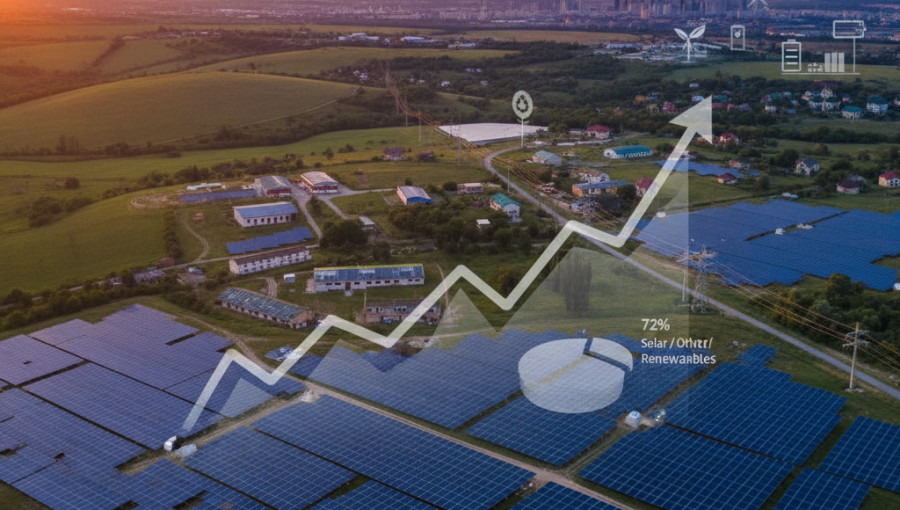
Moldova has reached a significant milestone in its energy transition, installing a record 315.7 MW of solar capacity in 2025. This surge brings the nation’s total solar power to 710 MW, accounting for over 70% of its nearly 1 GW renewable energy portfolio. Driven by successful government auctions and a robust regulatory framework, the country is rapidly approaching its 2030 goal of generating 30% of its electricity from renewable sources, signaling strong confidence from both domestic prosumers and international investors.
According to data from the National Centre for Sustainable Energy (CNED), Moldova’s solar sector experienced unprecedented growth last year, surpassing the 209 MW added in 2024. Solar energy is now the primary pillar of the country’s green energy mix, representing 72% of the 980 MW of total renewable capacity installed by the end of 2025.
A defining factor in this expansion was the implementation of the country’s first renewables auction based on a fixed-price support scheme. The initiative, which targeted 60 MW of solar and 105 MW of wind capacity, saw high demand and was ultimately oversubscribed. The Ministry of Energy confirmed that 11 winners were selected to receive 15-year fixed-price guarantees at MDL 1.16 ($0.069) per kWh. By September 2025, all solar projects associated with this auction were fully operational.
State support mechanisms have been instrumental in this rollout, covering a total of 408 MW of solar deployment. This includes 151 MW dedicated to solar parks with a capacity of up to 1 MW. The prosumer market also remains vibrant, with 8,713 individuals and legal entities contributing 195 MW of cumulative capacity. While early participants utilized a net-metering framework, the country transitioned to a net-billing mechanism at the start of 2024 to better manage self-consumption and grid stability.
Investment interest extends beyond government-backed schemes, as evidenced by the 302 MW of solar capacity currently operating on the free market. The nation’s largest project, a 50 MW plant in the Strășeni district, serves as a benchmark for the industry. Spanning 0.95 square kilometers, the facility was completed in a record eight months. It operates on a split model, selling 24 MW of its output at a fixed price via the national auction and the remaining 26 MW on the open market.
To streamline infrastructure development, the Moldovan government introduced new mandates in early 2025 requiring developers to provide financial guarantees for grid connection permits. This measure successfully cleared 109 MW of grid capacity by mid-year by filtering out speculative projects. Furthermore, the introduction of guarantees of origin certificates has added a new layer of transparency and value to the local renewable energy market.
Looking ahead, Moldova aims to meet 27% of its total final energy consumption through renewables by 2030. Recent legislative updates, including Government Decision No. 599/2025, seek to further incentivize the integration of energy storage solutions and ensure the regulatory framework remains attractive for large-scale international investment. Currently, renewables account for an estimated 29% of the nation’s gross final electricity consumption.