
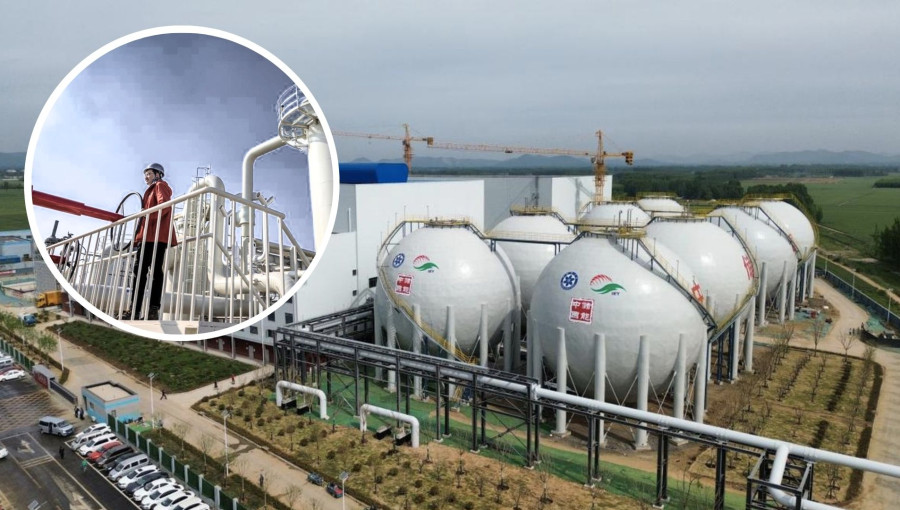
China has successfully operationalized the world’s largest compressed air energy storage station in Jiangsu Province, marking a significant milestone in sustainable energy infrastructure. The Huai’an salt cavern project features a total capacity of 600 MW and can store up to 2,400 MWh of energy. By utilizing abandoned salt mines as massive underground reservoirs, the facility provides grid stability and peak shaving capabilities. This $520 million initiative is expected to power approximately 600,000 households annually while significantly reducing CO2 emission and coal consumption in the region.
The Huai’an Salt Cavern Compressed Air Energy Storage (CAES) project has reached full operational status following the successful grid connection of its second unit. This facility now stands as the largest of its kind globally, integrating advanced storage technology to bolster the national power grid. With the completion of Unit 2, which achieved full-load power generation on its first attempt, the station is ready to provide critical peak-shaving and frequency regulation services to support China’s evolving energy landscape.
Developed with a total investment of $520 million, the station consists of two 300 MW units, providing a cumulative installed capacity of 600 MW and a massive storage volume of 2,400 MWh. The project utilizes high-temperature adiabatic compression technology, specifically a “molten salt + pressurized thermal water” system. This non-supplementary combustion method allows the plant to store and reuse heat generated during compression without burning fossil fuels, maintaining a conversion efficiency of approximately 71%.
The facility functions like a massive underground “power bank” by repurposing abandoned salt mine caverns located between 1,150 and 1,500 meters beneath the surface. During periods of low electricity demand, the system uses surplus energy to compress air into these deep chambers. When demand peaks, the high-pressure air is released to drive turbines and generate electricity. This mechanism is essential for mitigating the inherent volatility and intermittency of renewable energy sources.
Core components for the station, including air turbine units, motors, and molten salt storage tanks, were supplied by Shanghai Electric. According to China Energy Digital Technology Group Co., Ltd., one of the primary investors, the project’s performance metrics in terms of single-unit power and storage capacity are currently unmatched by any other salt cavern CAES plant in the world.
On an annual basis, the station is projected to generate roughly 792 million kWh of electricity, which is sufficient to meet the needs of 600,000 households. Beyond its energy output, the project offers substantial environmental advantages by eliminating the need for 250,000 tons of standard coal and preventing the release of 600,000 tons of CO2 emission every year. This initiative represents a major step forward in the region’s transition toward a low-carbon energy system.