
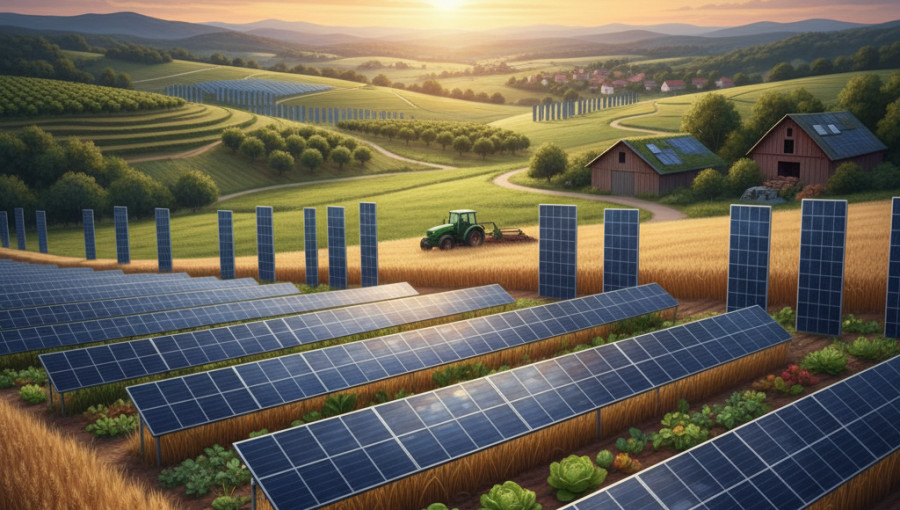
A recent industry analysis challenges the perception that agrivoltaic systems are prohibitively expensive compared to traditional ground-mounted solar installations. While a previous German study highlighted high costs for specialized elevated setups, expert Jochen Hauff argues that vertical and tracker-based configurations offer significant economic advantages. By accounting for higher market revenues during peak demand and superior land-use efficiency, these advanced agrivoltaic designs can compete with conventional solar while preserving up to 80% of agricultural land for farming.
The debate centers on a report from the Thünen-Institut, which suggested that agrivoltaic projects could face costs up to 148% higher than standard solar farms. Hauff contends that this figure is misleading, as it focuses primarily on complex, elevated structures used in orchards rather than more affordable alternatives. He emphasizes that the true economic value of a project depends not just on the levelized cost of electricity, but on the potential market revenue generated by specific production profiles.
Data indicates that vertical agrivoltaic systems may only incur a 4% cost premium, while tracker-based systems—which follow the sun’s path—typically cost between 12% and 13% more than fixed installations. Crucially, a study by the Institute of Energy Economics at the University of Cologne revealed that tracker systems could achieve a 43% higher market value. This is due to their ability to generate electricity during morning and evening hours when demand and prices are often higher, simultaneously easing pressure on the power grid.
Beyond financial returns, land-use efficiency remains a primary benefit of integrating solar with agriculture. Traditional ground-mounted solar plants often occupy an entire hectare for a specific unit of power generation. In contrast, vertical systems reduce this footprint to 0.4 hectares, and tracker systems require only 0.2 hectares. This footprint reduction allows farmers to maintain 60% to 80% of their land for active crop production.
Furthermore, these systems provide physical protection for crops, acting as buffers against heavy rainfall, wind erosion, and extreme solar radiation. By improving soil moisture retention, agrivoltaics serve as a dual-purpose tool for rural development, enhancing both economic stability and environmental resilience against climate change. Rather than being viewed as a niche high-cost technology, Hauff concludes that these systems are essential for strengthening the physical and financial security of rural areas.