
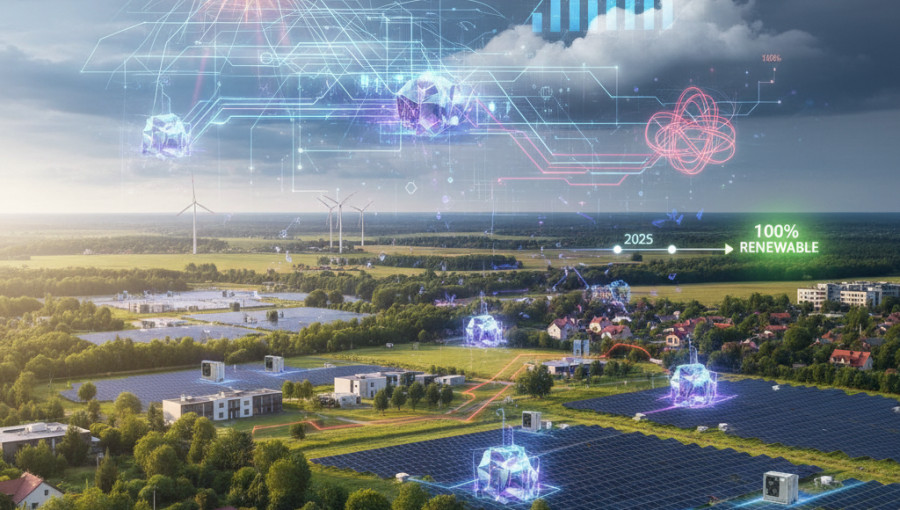
Lithuania has reached a significant renewable energy milestone, with its total solar capacity climbing to 3,040 MW by the end of 2025. Driven by progressive state policies and a robust prosumer market, the country added approximately 600 MW in a single year. While technical permits for an additional 4 GW have been granted, the focus is now shifting toward grid integration and energy storage. With solar and wind already meeting nearly 70% of demand, the Baltic nation is prioritizing battery systems to sustain its momentum toward a 100% renewable energy grid by 2030.
According to the latest figures from the International Energy Agency’s Photovoltaic Power Systems Programme (IEA-PVPS), Lithuania’s solar sector continues to show impressive growth. By the close of 2025, the nation’s cumulative capacity reached 3,040 MW, up from 2.4 GW the previous year. This expansion resulted in the generation of 1.79 TWh of electricity, accounting for 14.2% of the country’s total power consumption. On a per capita basis, Lithuania now provides 1,053 kW, positioning it as one of the European Union’s leading performers in solar adoption.
The surge is largely credited to the Ministry of Energy’s forward-thinking policies and a massive base of 170,000 prosumers. These individual and small-scale producers were responsible for roughly 70% of all solar electricity generated in 2025. While households and non-profit organizations still benefit from net-metering schemes, commercial entities have moved to a net-billing system—a transition expected to eventually encompass all new producers. Additionally, public subsidies covering up to 30% of installation costs have further incentivized small and medium-sized enterprises to adopt solar technology.
While small-scale installations dominate, utility-scale projects are also expanding. Lithuania’s current largest operational site reaches 100 MW, with Green Genius developing two additional 91 MW projects. However, the rapid expansion has led to grid congestion. Experts note that the market is nearing saturation because the combined output of solar and wind already meets over 68% of national demand. This success has outpaced existing grid development, making it increasingly difficult for new prosumers to secure technical permits without integrated storage solutions.
To overcome these infrastructure hurdles, Lithuania is pivoting toward storage technologies. In 2025, technical permits were issued for nearly 2 GW of battery energy storage system (BESS) facilities. A major energy storage tender held earlier that year saw overwhelming interest, ultimately procuring 1.7 GW/4 GWh of capacity. Moving forward, the government is encouraging hybrid solar-plus-storage farms and standalone BESS units. New regulations also allow large-scale solar plants to share grid connection points with wind farms to stabilize the intermittent nature of renewable generation, supporting the country’s goal of total energy independence by 2030.