
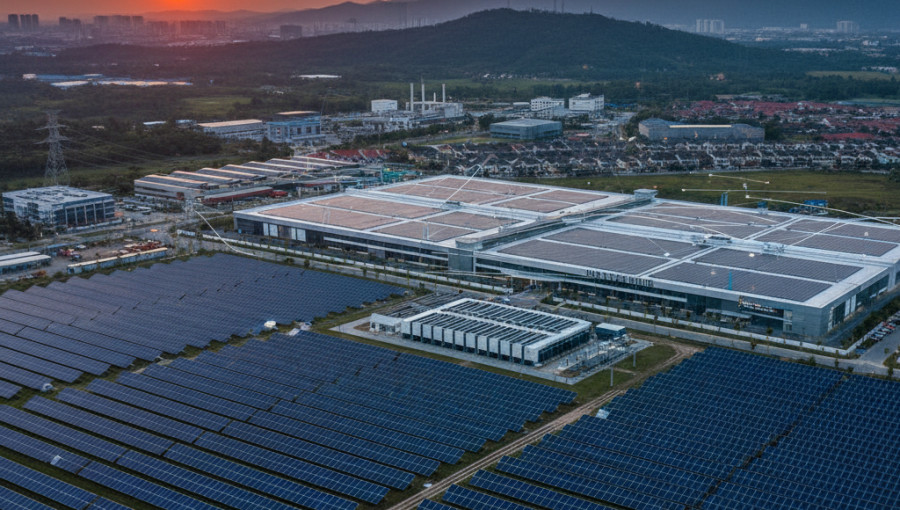
Malaysia has significantly expanded its renewable energy footprint, reaching a total cumulative solar capacity of 5,777 MW by the end of 2025. Data from the International Energy Agency’s Photovoltaic Power Systems Programme (IEA-PVPS) reveals that the nation added approximately 1.4 GW of solar power within a single year, marking a period of rapid growth. This surge was primarily driven by successful utility-scale auctions and net-metering initiatives. Moving into 2026, the government has introduced the Solar Accelerated Transition Action Program (ATAP) to further streamline adoption across the residential and commercial sectors.
The total capacity of 5,777 MW includes installations from three primary government frameworks: Large-Scale Solar (LSS), the legacy Feed-in Tariff (FiT) system, and Net Energy Metering (NEM). By the close of 2025, the LSS program—a competitive auction scheme for utility projects—accounted for 2,648 MW of the total. The most recent auction round, launched in early 2025, approved 13 projects totaling nearly 2 GW, with individual project capacities ranging from 10 MW to 500 MW. According to the Ministry of Energy Transition and Water Transformation, the LSS initiative has approved over 6 GW of capacity since its inception.
Distributed solar has also played a vital role in Malaysia’s energy transition. The NEM scheme, which supports residential, commercial, and industrial (C&I) installations, contributed 2,747 MW before concluding in mid-2025. Meanwhile, the older FiT program, which provided fixed tariffs for small-scale rooftop solar before being phased out in 2016, accounts for a remaining 345 MW. Experts suggest the actual national capacity could be even higher when accounting for off-grid systems and installations outside government-regulated schemes.
In early 2026, Malaysia transitioned from the NEM framework to the Solar Accelerated Transition Action Program (ATAP). This new initiative is designed to remove previous quota constraints and simplify the approval process for rooftop solar projects. While ATAP focuses heavily on self-consumption and currently offers no benefits for exporting excess electricity to the grid, analysts believe it will be a major catalyst for growth. High commercial electricity tariffs are already making solar an attractive investment for the C&I sector.
Looking forward, the development of massive data centers is expected to become a cornerstone of the Malaysian solar market. One of the most significant projects currently under development is a 1.5 GW solar installation paired with battery storage, designed specifically to power hyperscale data centers. This project operates under the Corporate Renewable Energy Supply Scheme, allowing corporations to procure green energy directly from developers.
To maintain this momentum, energy analysts suggest that the government should focus on standardizing grid connection approvals and increasing transparency regarding hosting capacity. Furthermore, reforms to electricity pricing and the reduction of indirect subsidies for natural gas and coal are seen as essential steps to ensure that solar remains competitive in the long term. Given these factors, industry experts forecast that solar deployment in 2026 will likely surpass the record-breaking figures seen in 2025.