
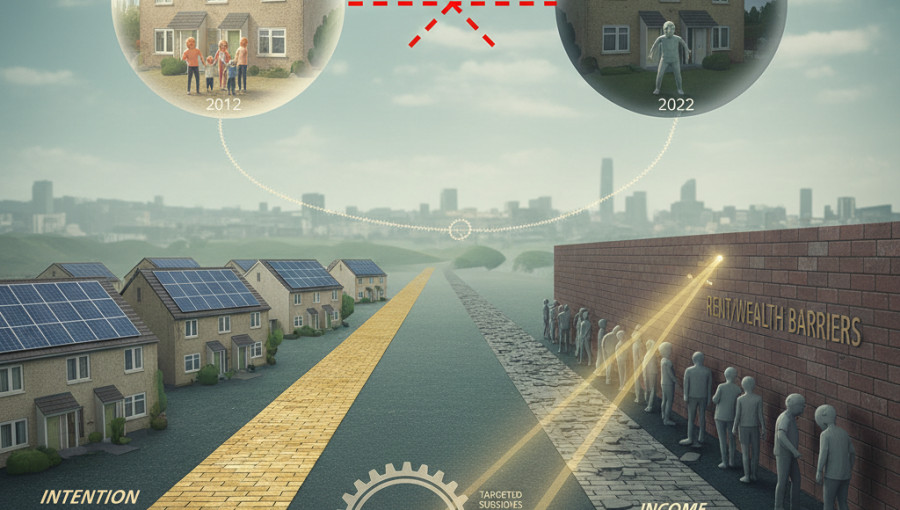
A recent study into UK residential energy trends has revealed a significant gap between the desire to install solar panels and actual implementation. Analyzing longitudinal data spanning nearly a decade, researchers found that while 90% of households with serious intentions in 2012 had yet to adopt the technology by 2022, intention remains a more reliable predictor of future installation than income levels or environmental attitudes. The findings suggest that government policies must evolve beyond simple subsidies, potentially introducing reverse auctions and specific initiatives for renters to bridge the gap between consumer interest and solar panel adoption.
The research, published in the journal *Energy Economics*, explores the complex relationship between a homeowner’s intent and the eventual installation of renewable energy systems. Utilizing data from the UK Household Longitudinal Study—one of the largest panel surveys globally, covering approximately 40,000 households—researchers analyzed adoption patterns over a ten-year period. The team, involving experts from Macquarie University, Charles Darwin University, and Queen Mary University of London, examined data from three distinct windows: 2012-13, 2018-19, and 2021-22.
The findings indicate that while many residents express a strong interest in renewable energy, those intentions often fail to result in immediate action. Specifically, nearly 90% of households that reported they were “seriously considering” solar panel installations during the 2012-13 period had still not followed through by the 2021-22 follow-up. However, the study emphasizes that having a serious intention is still a powerful metric; it increases the likelihood of adoption by three to seven percentage points. This influence outweighs other traditional factors, such as household income or general environmental perceptions, which only accounted for a zero to two percentage point increase in adoption probability.
Interestingly, the research highlighted that even an initial rejection can eventually lead to a positive outcome. Households that had considered but ultimately decided against solar power in 2012-13 were more likely to have installed a solar module by 2021-22 than those who had never given the technology any thought. According to Rohan Best, the report’s corresponding author from Macquarie University, this suggests that the mere act of evaluating solar options creates a foundation for future adoption, even if initial barriers like cost or property suitability temporarily halt the process.
The analysis also revealed that income is a less significant driver than previously assumed. Instead, the ability to adopt solar is more closely tied to overall material wealth and housing status. Renters, in particular, face unique obstacles that prevent them from participating in the energy transition. To address this, the researchers advocate for a shift in government strategy. Best suggests that instead of broad-based subsidies that may over-fund some while neglecting others, governments should explore more targeted mechanisms like equitable reverse auctions.
Under a reverse auction model, households could bid for support based on their specific financial needs, allowing for a more cost-effective and fair distribution of resources. This could include sub-auctions tailored to specific economic groups or wealth brackets to ensure households compete with others in similar financial positions. Furthermore, the study calls for dedicated policies for the rental market, noting that renters represent a massive, untapped demographic for solar panel deployment worldwide. The researchers believe these insights can serve as a blueprint for international policy design, helping to streamline the adoption of both solar panels and home battery systems.