
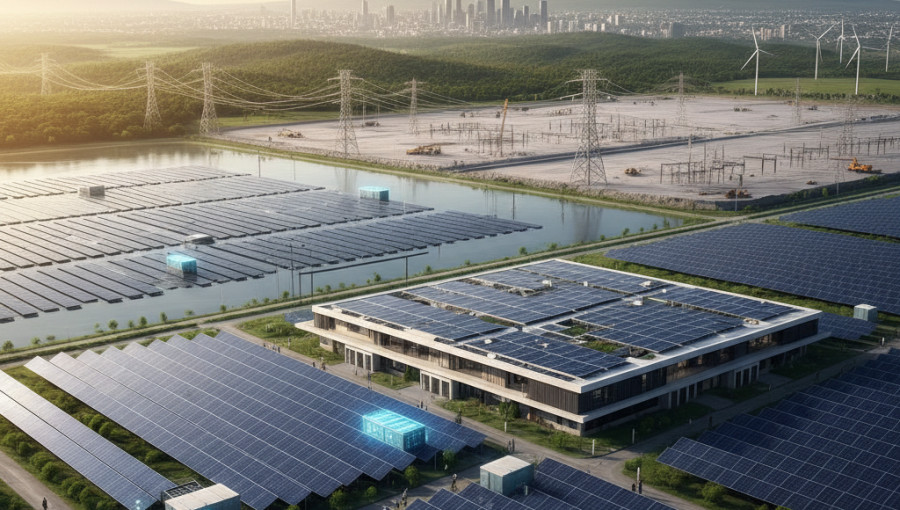
The Philippines significantly expanded its solar infrastructure in 2025, adding 899 MW of new capacity to reach a cumulative total of nearly 3.9 GW. According to the International Renewable Energy Agency (IRENA), this growth is primarily fueled by the government’s Green Energy Auction program and declining technology costs. While ground-mounted installations currently dominate the landscape, the country is diversifying into floating solar and large-scale integrated storage projects. With a massive pipeline of upcoming developments, the Philippines is positioned to further accelerate its transition toward a renewable-heavy energy mix.
Data from IRENA’s Renewable Capacity Statistics 2026 report indicates that the nation’s total solar footprint reached 3,892 MW by the end of 2025, a substantial increase from the 2,993 MW recorded the previous year. The Department of Energy (DOE) notes that the vast majority of this capacity—approximately 3,492 MW—comes from ground-mounted installations, while behind-the-meter systems account for just 52 MW. Analysts attribute this momentum to the success of the Green Energy Auction (GEA) initiative, which recently concluded a fourth round that allocated over 10 GW of combined solar, wind, and storage capacity.
The government is now looking toward the GEA-7 phase, which will prioritize a mix of ground-mounted, rooftop, and floating solar systems. This is part of a broader strategy to secure an additional 25 GW of renewable energy by 2035. In the commercial and industrial sectors, adoption is being driven by rising electricity costs and corporate sustainability mandates. Meanwhile, the residential sector achieved a milestone with the completion of the 6.5 MW Ning Ning solar rooftop project, a grid-connected installation integrated into a social housing community.
Major utility-scale developments also reached operational status last year. The 197 MW Citicore Solar Batangas 1 project, paired with a 320 MWh battery energy storage system, has been recognized as the country’s first solar baseload facility. Additionally, ACEN continues to expand the SanMar solar project in Zambales. Built on 500 hectares of land covered by volcanic material from the 1991 Mount Pinatubo eruption, the site currently has 384 MW operational and is expected to reach its full 585 MW capacity by 2027.
Innovation is also extending to water-based installations, with the completion of a 4.99 MW floating solar plant on the Malubong reservoir. Experts anticipate further growth in this niche as research identifies several domestic dams as ideal locations for PV deployment. Looking ahead, the massive Terra Solar project is expected to set new benchmarks. Having achieved grid synchronization in February, the site will eventually combine 3.5 GW of solar with 4.5 GWh of storage, making it one of the largest integrated facilities of its kind globally.
To sustain this growth, industry experts suggest policy adjustments to the country’s net-metering framework. Current recommendations include raising the 100 kW capacity cap for net-metering and easing the 30% export limit on distributed energy resources. Strengthening grid integration and expanding the digital “one-stop shop” for power project approvals are also seen as critical steps to maintaining the Philippines’ trajectory as a regional leader in solar energy.