Tandem PV Launches California Factory For Perovskite Solar

Tandem PV, a clean energy startup, is launching a 6,038-square-meter manufacturing facility in Fremont, California, to transition perovskite solar technology from the laboratory to commercial production. By layering a perovskite coating onto traditional silicon solar cells, the company aims to boost solar panel efficiency from the industry standard of 22% to 30%. This development represents a significant step in overcoming the historical challenges of scaling perovskites, potentially allowing the United States to leapfrog current market leaders in solar module performance and domestic manufacturing.
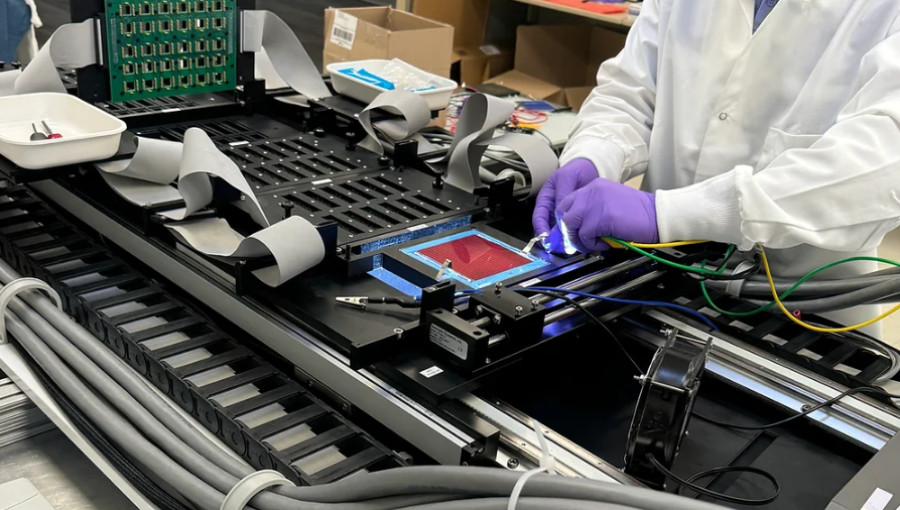
The new automated facility, located in the same industrial hub where Tesla established its first major electric vehicle plant, serves as a critical bridge between experimental research and utility-scale deployment. The factory has begun producing panels that are 60 times larger than the 10-centimeter by 10-centimeter glass squares used in previous research and development. While these modules are still about a quarter of the size of standard utility-scale solar panels, they are designed to prove that the technology can survive the rigors of the real world.
The core of the innovation lies in a "tandem" configuration. By applying a 1-micron-thick layer of perovskite chemicals to glass and pairing it with a conventional silicon solar cell, the resulting "solar panel sandwich" captures a much wider spectrum of sunlight. While traditional silicon technology is rapidly approaching its theoretical efficiency limit in the high 20% range, perovskite-based systems have a theoretical ceiling of approximately 45%. Tandem PV’s current modules already produce roughly one-third more energy than standard panels within the same physical footprint.
The manufacturing process differs significantly from traditional silicon fabrication. At the Fremont site, robotic arms and slot-die coating machines—similar to those used in the window glass industry—apply the perovskite formula to large glass sheets. The material is then annealed to ensure proper crystallization. Unlike silicon cells, which require silver threads to conduct electricity, perovskites allow electricity to flow freely across their surface. Finally, a laser system etches the glass into thin strips that function as individual cells.
Currently, the factory has an annual capacity of 40 megawatts. Rather than focusing on immediate mass-market sales, the company is using this capacity to refine its process engineering and provide modules to major American developers for field testing. These trials will evaluate how the panels perform in diverse climates, addressing long-standing concerns regarding the durability of perovskite materials. If these field tests are successful, Tandem PV intends to scale up to full-size solar module production by 2028 at a larger facility.
This shift toward domestic perovskite production could offer the U.S. a strategic advantage in the global renewable energy market. While the global supply chain is currently dominated by silicon manufacturing in China, perovskite technology offers a path toward high-efficiency energy production that does not rely on the same infrastructure. By proving that these advanced materials can be manufactured reliably at scale, Tandem PV aims to break the long-standing impasse that has kept this promising technology confined to the laboratory.