
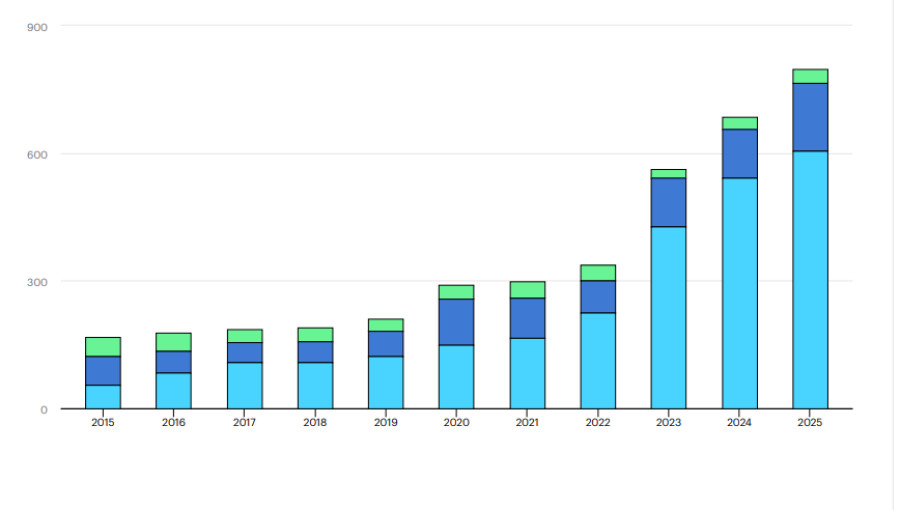
The International Energy Agency’s (IEA) Global Energy Review 2025 reveals that global solar PV installations surpassed 600GW last year, representing more than a quarter of the total growth in global energy demand. This unprecedented surge has established solar as the primary driver of new energy supply, with cumulative global capacity reaching approximately 2.8TW. Record-breaking deployment in China, India, and the European Union, alongside increasing competitiveness in emerging markets, has solidified solar PV as the world’s leading power generation technology by capacity, significantly displacing fossil fuel reliance.
According to the latest IEA data, solar PV expansion grew by approximately 12% year-on-year in 2025. This rapid scaling means that solar now stands as the largest installed power generation technology globally. The geographical reach of the industry is also widening significantly; more than 30 nations added over 1GW of capacity in 2025, nearly doubling the number of countries reaching that milestone compared to just five years ago.
While global energy demand rose by 1.3% over the year, electricity consumption grew at more than twice that pace. Solar PV alone accounted for over 25% of the total increase in the world’s energy supply, marking the first time a modern renewable source has led absolute global expansion. Combined with nuclear power, renewables met nearly 60% of new demand. Natural gas followed as the second-largest contributor at 17%, though it remained far behind the growth trajectory set by solar.
IEA Executive Director Fatih Birol noted that electricity consumption is outstripping overall energy demand, with solar PV emerging as the clear leader. He highlighted that for the first time in history, solar accounted for more than a quarter of all global energy demand growth, outpacing every other individual energy source.
China maintained its position as the primary engine of this growth, commissioning nearly 370GW of solar PV in 2025—representing more than half of all global additions. This 13% increase over the previous year was partly fueled by developers rushing to complete projects before regulatory shifts moved the market from fixed tariffs to competitive auctions. While this policy change led to a slowdown in the second half of the year, China still accounted for over 60% of the world’s renewable capacity growth.
In Europe, the European Union achieved its highest annual installation rate to date, adding nearly 70GW of solar PV. Germany remained the regional leader with 17GW, followed by a record-breaking 14GW in Spain. Emerging markets in the bloc, including Lithuania and Romania, also hit new highs due to favorable policy frameworks and grid-scale expansions.
India stood out as the fastest-growing major market, with solar PV installations jumping nearly 60% to reach 50GW. Growth was driven by a combination of massive utility-scale projects and a rising number of distributed systems. Meanwhile, in the Middle East, Saudi Arabia quadrupled its annual additions to 7GW, and South Africa led sub-Saharan Africa’s progress by contributing 3GW to the region’s doubling of renewable capacity.
The IEA report emphasized that the 600TWh increase in solar generation during 2025 represents the largest single-year structural rise in electricity output from any technology in history. This shift has directly contributed to a global decline in coal-fired generation. Since 2019, the cumulative deployment of solar PV and other low-emission technologies has displaced fossil fuel demand equivalent to the annual energy consumption of all of Latin America. Despite persistent hurdles such as grid connection delays and supply chain pressures, solar remains the fastest-expanding energy technology for the third year running.