
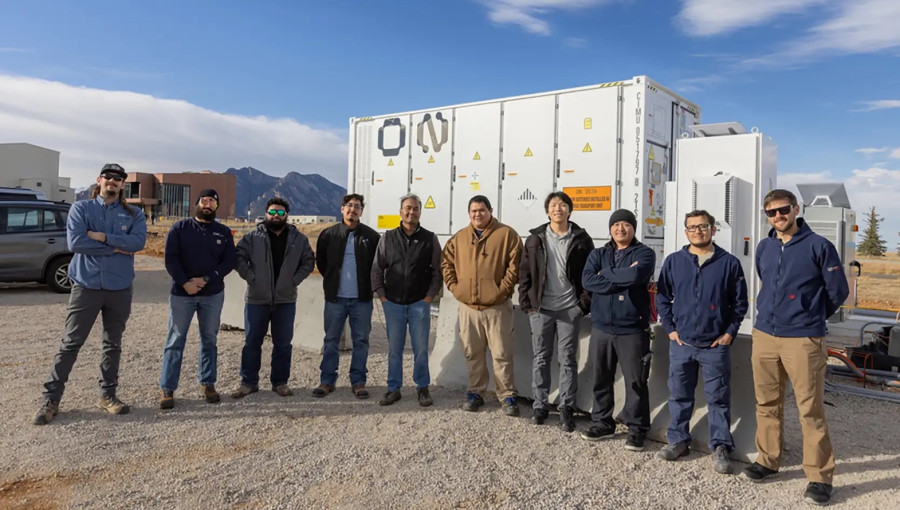
The National Laboratory of the Rockies (NLR) has launched a pioneering testing program for ON.energy’s “AI UPS” technology, a system designed to bridge the gap between volatile data center energy demands and power grid stability. As hyperscale data centers continue to expand, their rapid power fluctuations pose significant risks to electrical infrastructure. By utilizing the unique ARIES simulation platform, researchers can evaluate how this specialized uninterruptible power supply manages extreme energy spikes and grid disturbances in a controlled environment, ensuring that these massive facilities become “good grid citizens” without threatening local power reliability.
The rapid expansion of data centers is placing unprecedented pressure on the power grid, with a single facility often consuming as much electricity as a small city. Unlike traditional urban loads, however, a data center’s power consumption can fluctuate wildly in less than a second, creating sharp energy spikes that can destabilize local infrastructure. To address this, ON.energy has developed an AI UPS specifically engineered to manage these compute-driven swings and protect the grid from sudden surges while providing backup during blackouts.
To validate this technology, ON.energy is collaborating with the NLR using their Advanced Research on Integrated Energy Systems (ARIES) platform. This facility is unique in the Western Hemisphere for its ability to simulate both a hyperscale data center and a complex power grid simultaneously. This “virtual sandbox” allows engineers to subject the AI UPS hardware to extreme scenarios—such as energy demand surges of up to 100% occurring in millisecond intervals—without risking actual power outages for the public or critical services like emergency response and air traffic control.
The testing, which began in early 2026 at the NLR’s Flatirons Campus, aims to demonstrate that data centers can maintain steady, reliable loads even at gigawatt scales. Grid operators are increasingly imposing strict requirements on new facilities before allowing them to connect to the system. By proving that the AI UPS can handle grid anomalies, storms, and faults, the partnership seeks to streamline the integration of new data centers while safeguarding the energy supply for nearby businesses, hospitals, and residential areas.
Beyond immediate hardware testing, the NLR team is utilizing digital modeling to create computational “building blocks” of energy architectures. This allows researchers to predict how the AI UPS will interact with various technologies, including nuclear facilities and hydropower plants. This multi-year partnership provides a blueprint for future energy management, offering a scalable way to identify and implement solutions for the evolving challenges of global energy demand and the growth of artificial intelligence infrastructure.