
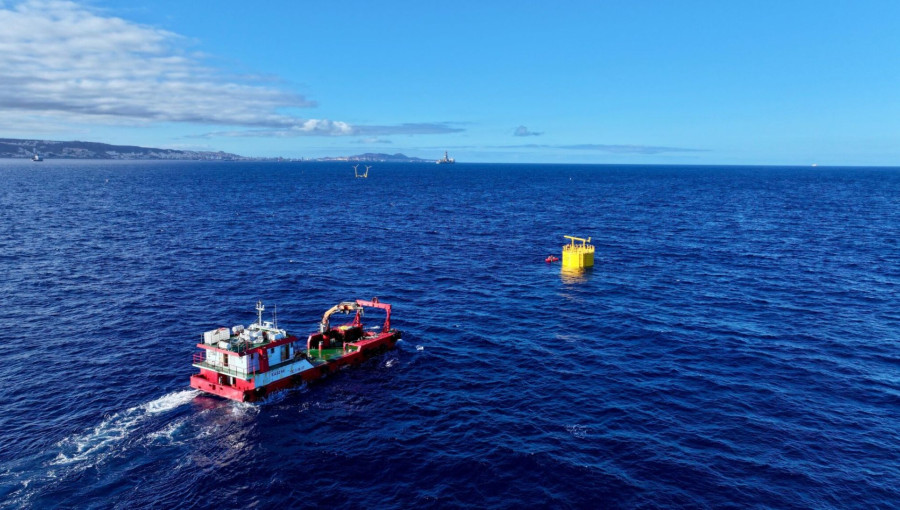
Global OTEC, a UK-based clean energy company, has successfully installed the world’s first purpose-built offshore platform for Ocean Thermal Energy Conversion in the Canary Islands. This milestone prototype, part of the EU-funded PLOTEC project, aims to harness the temperature difference between warm surface water and deep-sea cold water to provide continuous baseload power. By operating offshore, the system reduces necessary pipe lengths by 80 percent, overcoming significant logistical and financial barriers. This breakthrough marks a pivotal shift toward scalable, carbon-free energy solutions for tropical island nations currently reliant on expensive fossil fuel imports.
The project reached a major milestone this week with the successful deployment of a vertical seawater intake riser at the Oceanic Platform of the Canary Islands (PLOCAN). This critical structure is designed to draw freezing water from the ocean depths to the floating platform. Engineers consider the installation of this riser the most complex phase of the project, as it must withstand the volatile conditions of the open sea while maintaining a direct connection to the deep-sea thermal source.
Ocean Thermal Energy Conversion functions by exploiting the natural thermal gradient of the sea. Warm surface water is used to heat a working fluid with a low boiling point, creating vapor that drives a power-generating turbine. To complete the cycle, cold water is pumped from depths of approximately 1,000 meters to condense the vapor back into a liquid state. Because the ocean maintains these temperature differences regardless of the time of day or weather, the system can provide a steady supply of electricity around the clock.
While small-scale OTEC experiments have previously been conducted on land, they are often hindered by the immense cost and technical difficulty of laying kilometers of pipeline along the seabed to reach deep water. By moving the entire operation to a floating offshore platform, Global OTEC has managed to reduce the required piping by about 80 percent. This innovation makes the technology far more practical for utility-scale power generation and significantly lowers the capital investment required for installation.
This development is particularly significant for tropical islands that currently depend on imported diesel and heavy fuel oils. These regions often face volatile energy prices and logistical challenges that make traditional fossil fuels unsustainable. While solar and wind energy are part of the solution, land scarcity and inconsistent weather can limit their effectiveness. OTEC provides a reliable alternative that can replace up to 25 gigawatts of fossil fuel capacity across tropical regions by offering a constant, carbon-free power source.
The current testing phase is part of a €3.5 million program supported by the European Union’s Horizon Europe initiative. Following the successful validation of the prototype in Spanish waters, Global OTEC plans to launch its first commercial power module in Hawai’i. This next step aims to prove that offshore OTEC can deliver standardized, replicable energy at a scale comparable to established renewable technologies like wind and solar.