
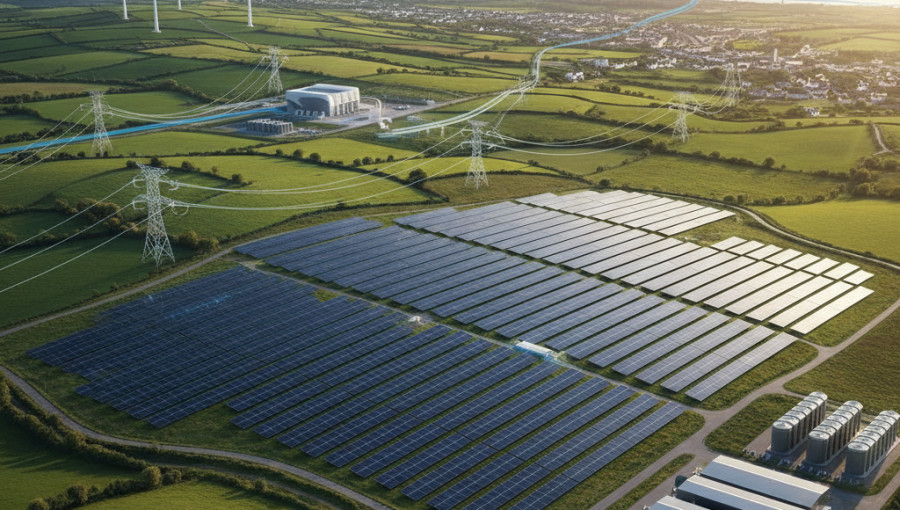
Ireland has reached a significant renewable energy milestone as grid-scale solar generation surpassed the 1 GW threshold for the first time. Data from Eirgrid, the national transmission system operator, confirms that several record-breaking peaks were recorded in mid-April, culminating in a high of 1,133 MW. This surge reflects the rapid expansion of solar farms across the country, which now provide enough electricity to power approximately 500,000 homes. While onshore wind remains the primary renewable source, solar’s contribution to the national grid continues to grow despite ongoing challenges regarding infrastructure and curtailment.
The 1 GW barrier was first broken on Monday, April 20, when generation reached 1,021 MW at midday. This record was quickly surpassed on April 24 with 1,087 MW, followed by a new peak of 1,133 MW the following afternoon. These figures represent a substantial leap from the previous year; in early 2024, peak generation levels typically hovered around 750 MW. Eirgrid’s National Control Centre noted that the steady increase in large-scale solar module deployments is fundamentally shifting the nation’s energy mix. Cathal Marley, CEO of Eirgrid, emphasized that successfully integrating these volumes requires balancing complex technical demands between variable renewable sources and conventional power generation.
The rapid ascent of solar energy is reflected in its increasing share of total electricity demand. In 2023, grid-scale solar accounted for just 1.1% of Ireland’s needs, rising to 2% in 2024 and reaching 3.1% by early 2025. Industry body Solar Ireland reports that the country’s total installed capacity—encompassing residential, commercial, and utility segments—has now reached approximately 2.5 GW. In 2024 alone, 1 GW of new solar installations were added to the system, and a development pipeline of 1.7 GW in grid-scale projects suggests that further records are imminent as more sites become operational.
Despite this progress, the Irish energy system faces significant hurdles in managing surplus power. During the first half of 2024, approximately 89 GWh of solar generation was curtailed because the grid could not absorb the supply. Analysts have warned that curtailment levels have increased seven-fold since 2022, highlighting a critical need for modernized grid infrastructure and energy storage solutions. To address these bottlenecks, the Irish government approved a record €1.1 billion funding package for grid upgrades. Furthermore, the Commission for Regulation of Utilities (CRU) recently introduced a policy allowing solar and battery storage projects to share a single grid connection, a move designed to maximize the efficiency of existing infrastructure.
Ireland is also looking toward international partnerships to bolster energy security and transition goals. Climate Minister Darragh O’Brien recently signed a memorandum of understanding with Spain to explore the development of a subsea electricity interconnector between the two nations. Additionally, an existing agreement with the United Kingdom was extended to deepen cooperation on renewable integration. As Ireland prepares for its upcoming presidency of the Council of the European Union, the government has signaled that advancing the European Grids Package and accelerating clean energy infrastructure will be top priorities.