
Researchers at Rice University have achieved a major breakthrough in solar energy by developing perovskite solar cells that retain 98% of their efficiency after 1,200 hours of exposure to temperatures of 90 degrees Celsius (194°F). While halide perovskites have long been considered a cost-effective alternative to silicon, their commercial viability has been hindered by structural instability under heat. This new study, published in the journal Science, demonstrates how a novel chemical additive approach can stabilize these materials, offering a path toward durable, high-performance solar modules capable of withstanding extreme environmental conditions.
The core challenge with perovskites lies in their crystal structure, which can easily shift into a “yellow phase” that reflects light rather than absorbing it. To combat this, the research team introduced a combination of a two-dimensional perovskite and formamidinium chloride into the precursor solution. This mixture acts as a template for crystal growth, regulating the crystallization process and creating compressive strain within the lattice. This strain keeps the material in its “black phase,” the state necessary for efficient light absorption.
According to the researchers, the addition of chlorine significantly alters the degradation pathway of the material. Instead of breaking down through a traditional low-energy process, the modified perovskite is forced through a higher-energy, “energetically uphill” route, which drastically slows its deterioration. The resulting films feature larger, better-aligned crystals, which minimize the internal weak points where degradation typically begins.
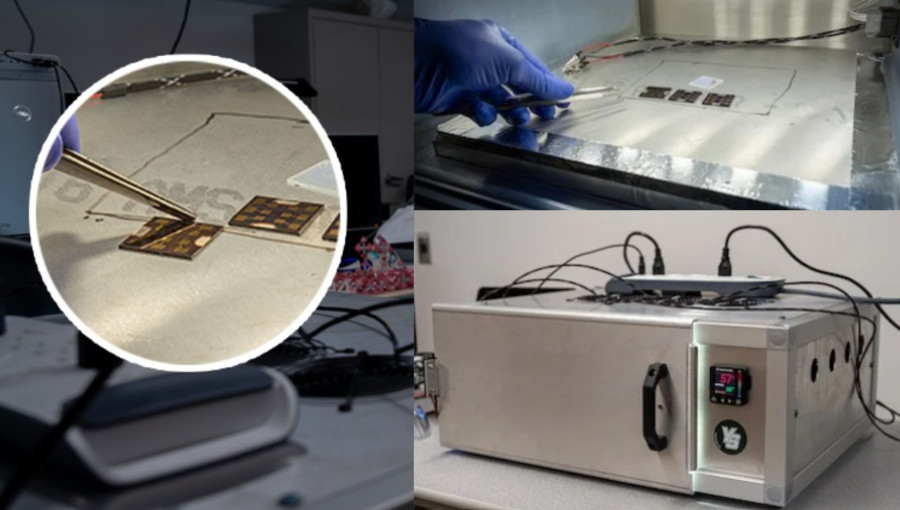
Beyond the chemical innovation, the team at Rice University also upgraded their testing capabilities. Moving away from traditional setups that could only evaluate one device at a time, they developed a new degradation unit capable of monitoring up to 100 solar cells simultaneously under accelerated aging conditions. This high-throughput testing confirmed the long-term stability of the new formula across dozens of devices.
These findings are particularly promising for the development of tandem solar cells, which layer perovskites with traditional silicon to reach efficiency levels exceeding 30%. By solving the durability issue, researchers believe perovskites can finally move from the laboratory to large-scale industrial applications, potentially revolutionizing the renewable energy sector with cheaper and more resilient solar technology.