
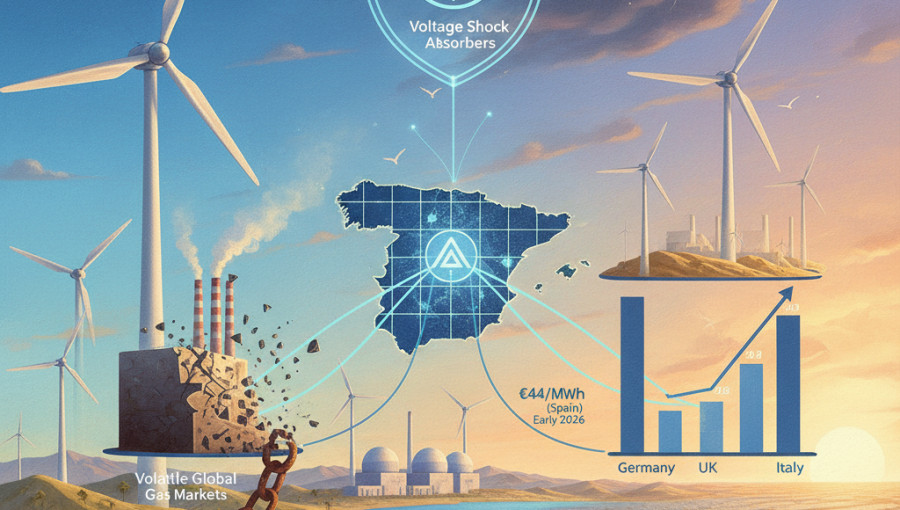
Spain has undergone a radical transformation to become one of Europe’s most affordable electricity markets, recording an average wholesale price of €44 per megawatt-hour during the first four months of 2026. This shift places the nation significantly below major economies like Italy, Germany, and the UK, where prices reached as high as €127. The primary driver of this trend is the aggressive substitution of fossil fuels with wind and solar power. Since 2022, renewable generation has consistently outperformed fossil sources, effectively decoupling Spanish electricity prices from volatile global gas markets.
The current price landscape marks a dramatic reversal from a decade ago when Spain was considered a cautionary tale of expensive energy and stranded investments. Today, the Spanish market is not only cheaper than the central-European bloc but is also challenging the historically low-cost hydro and nuclear sectors of the Nordic countries. While Italy and the UK struggle with wholesale costs exceeding €100 per megawatt-hour, Spain’s reliance on a diverse renewable mix has provided a competitive edge that continues to widen the gap with its neighbors.
The structural backbone of this change lies in the rapid phasing out of coal and the diminishing role of gas. Twenty-five years ago, coal accounted for a third of the nation’s power; today, it has been virtually eliminated. While gas served as a bridge fuel in the late 2000s, its share has dropped to roughly 19%. In its place, wind and solar have surged, contributing 20% and 22% respectively to the total generation by 2025. By the first quarter of 2026, the combination of wind and solar reached 44% of total output, while fossil fuels plummeted to just 17%.
This shift has fundamentally altered how electricity is priced. In typical European wholesale markets, the most expensive plant required to meet demand—usually a gas-fired facility—sets the hourly price. In 2022, gas set the price in Spain during 55% of all hours. However, by early 2026, this “marginal price-setter” role for gas dropped to just 9%. As renewables increasingly cover the load, the market price is no longer tethered to the fluctuations of gas costs, leading to more frequent periods of low-cost energy.
Despite the drop in wholesale rates, retail consumers may not see an immediate equivalent reduction in their bills. Wholesale costs represent only a portion of the final price, which is heavily influenced by network charges, system stability costs, and taxes. In Spain, VAT and electricity excise taxes have fluctuated recently, and the cost of maintaining grid stability is rising as more transmission infrastructure is built to move renewable energy. Furthermore, the planned retirement of Spain’s nuclear fleet between 2027 and 2035 poses a potential risk; if low-carbon alternatives do not scale quickly enough, gas may once again exert upward pressure on prices.
The transition has also faced scrutiny regarding reliability, particularly following a major blackout in April 2025. While initial reports blamed renewable intermittency, official investigations confirmed the issue was related to grid voltage stability rather than a lack of generation. Experts suggest that Spain is currently a “pioneer” for the rest of Europe, facing technical challenges that all nations will eventually encounter as they modernize their grids. By integrating advanced voltage control and stabilization technologies, Spain is demonstrating that a high-renewable system can remain both affordable and resilient.
https://janrosenow.substack.com/p/spain-just-became-one-of-europes