
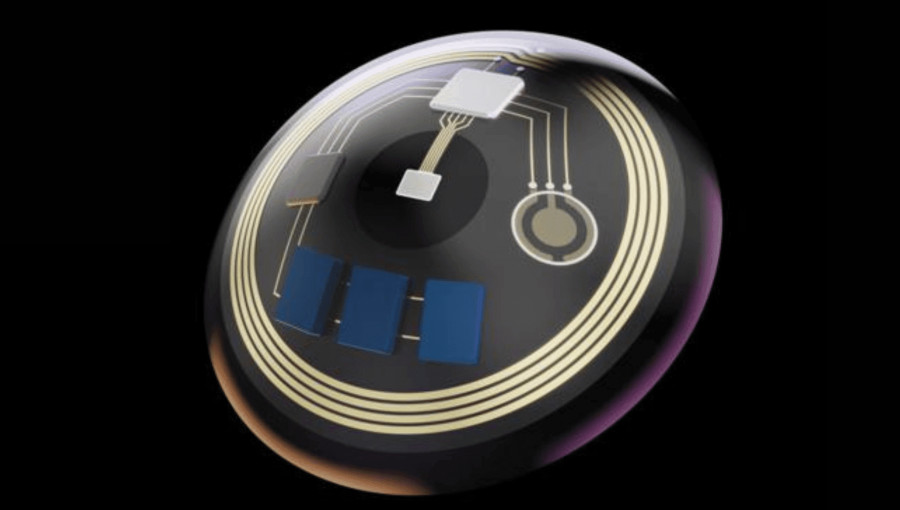
Deep-tech firm XPANCEO and energy-storage specialist ITEN have successfully developed a micro-scale solid-state battery designed for integration into smart contact lenses. This proof-of-concept addresses the primary obstacle in wearable eye technology: providing sufficient power for augmented reality displays without compromising safety or comfort. By utilizing ceramic nanomaterials instead of volatile liquid electrolytes, the partnership has created a stable, high-performance energy source that fits within the thin profile of a contact lens, marking a significant milestone toward the commercialization of next-generation intelligent vision systems.
The evolution of contact lenses from simple vision correction tools into sophisticated wearable computers has long been hindered by the limitations of traditional battery technology. Standard lithium-ion batteries are unsuitable for ocular use due to their tendency to leak, overheat, or swell—risks that are unacceptable for a device placed directly on the eye. While medical devices like pacemakers rely on bulky titanium shells for protection, smart lenses require a much more compact and flexible solution that can power high-energy functions such as augmented reality displays.
To overcome these hurdles, XPANCEO and ITEN focused on solid-state battery architecture. Unlike traditional batteries, these units utilize ceramic materials rather than liquids. This design choice ensures that even in the event of a failure, the battery simply ceases to function rather than leaking or exploding. ITEN’s contribution involves specialized nanomaterials featuring microscopic pores, which allow the battery to maintain high power density within a minimal footprint.
The engineering team also developed a sophisticated integration system to ensure the battery remains secure and functional within the lens. This includes a multi-stage sealing process and a custom energy harvester designed to capture power from fluctuating wireless signals. Dr. Valentyn Volkov, founder and CTO of XPANCEO, noted that the project required a fundamental shift in energy storage at the micro-scale, as existing supply chains did not offer the necessary components for such a specialized application.
This collaboration represents a shift toward a new category of electronic components specifically designed for highly integrated systems. By proving that these high-power microbatteries can be manufactured at scale, the companies are paving the way for the next generation of augmented reality and health-monitoring wearables. Vincent Cobée, CEO of ITEN, emphasized that the non-flammable, stable architecture of the solid-state battery provides the necessary reliability for a device where space is at a premium and safety is the highest priority.