Michael Jantzen Unveils Innovative Rotating Eco Aquaponic House
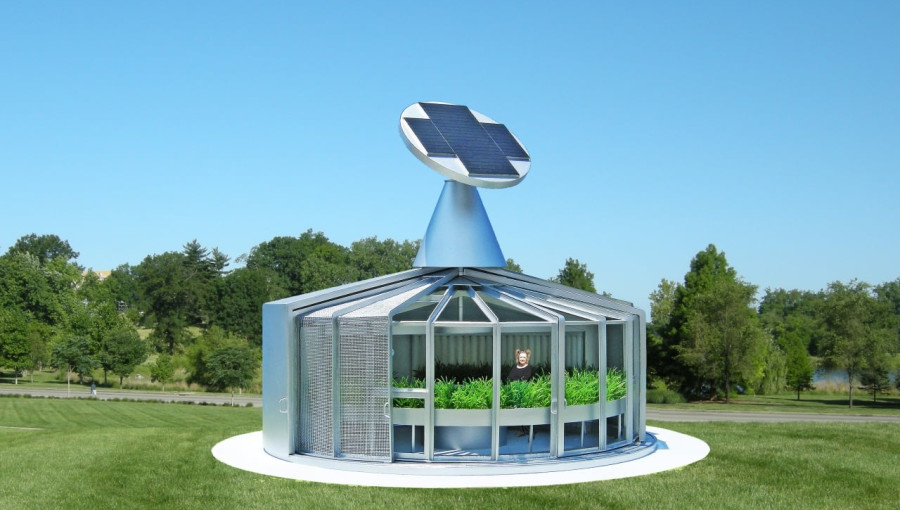
Michael Jantzen has unveiled the Eco-Aquaponic House, an innovative, self-sustaining structure designed to integrate food production with architectural efficiency. This rotating facility combines fish farming and plant cultivation in a closed-loop system, utilizing passive thermal management and solar energy to maintain optimal growing conditions year-round. Created as a public exhibit for a botanical garden, the house functions as a self-regulating machine that minimizes waste and energy consumption. By merging art with sustainable technology, Jantzen offers a glimpse into the future of urban food production and climate-resilient agriculture.
The Eco-Aquaponic House represents a significant leap in sustainable food production, moving beyond utilitarian greenhouses to create a fully integrated, self-regulating ecosystem. Designed by Michael Jantzen, a veteran in the field of sustainable architecture for over half a century, the structure was developed as a focal point for a botanical garden. It aims to demonstrate how technology and biology can work in harmony to produce food with minimal human intervention and zero synthetic additives.
At its core, the facility utilizes a biological loop where fish and plants sustain one another. Fish waste serves as a natural fertilizer, pumped through the roots of the surrounding vegetation. In turn, the plants act as a living filtration system, cleaning the water before it is recirculated back into the central fish tank. This closed-loop approach drastically reduces water consumption and eliminates the need for chemical fertilizers, making it a highly efficient alternative to conventional agriculture.
What distinguishes this structure is its dynamic, rotating design. The house is divided into six distinct sections that pivot around a central point to adapt to changing weather conditions. Two insulated panels are deployed during cold nights to trap heat, while two shade screens protect the interior from excessive sunlight on hot days. Additionally, two glass sections can be opened to provide natural ventilation. This mechanical flexibility allows the house to maintain a stable internal climate throughout the seasons without requiring massive energy inputs.
Thermal stability is further enhanced by a series of large tubes located around the perimeter of the stationary base. These tubes are filled with heat-retention materials that absorb solar energy during the day and release it as the temperature drops at night. This passive system ensures the fish and plants remain at optimal temperatures during the winter while preventing overheating in the summer.
The structure is powered by a sun-tracking solar cell array mounted on the roof. This array follows the sun’s path to maximize electricity generation, powering the facility’s internal systems and a large lamp positioned over the fish tank. Inside, the layout is designed for maximum efficiency, featuring a ring of plant trays surrounding the central cylindrical tank. While primarily an educational exhibit, the Eco-Aquaponic House serves as a functional model for the future of decentralized, energy-efficient urban farming.