
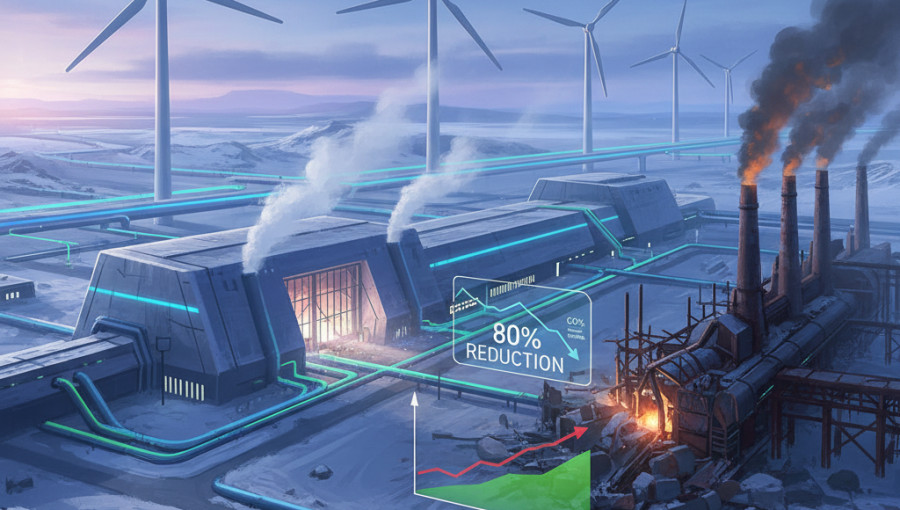
Europe is racing to decarbonize its steel industry, a sector responsible for nearly 9% of global CO2 emission. Leading the charge are Swedish ventures like Hybrit and Stegra, which utilize hydrogen-based direct reduction and electric arc furnaces to slash emissions by 80%. However, the transition faces significant headwinds, including high electricity costs, a lack of hydrogen infrastructure, and stiff competition from China. As the European Union phases out carbon allowances, steelmakers must choose between massive investments in clean technology or facing crippling emission fees that threaten the continent’s industrial future.
The transformation of the steel industry is centered in Luleå, Sweden, just 100 kilometers south of the Arctic Circle. This region is mirroring the industrial boom seen in 19th-century Pittsburgh, but with a focus on sustainability rather than coal. Traditional steelmaking remains a heavy polluter, releasing roughly 1.8 metric tons of CO2 emission for every ton of steel produced. In contrast, a new method using hydrogen for direct reduction, followed by processing in an electric arc furnace powered by renewable energy, can reduce those emissions to just 0.4 metric tons.
Hybrit Development—a collaboration between LKAB, SSAB, and Vattenfall—is at the forefront of this shift, having operated a pilot plant in Luleå since 2020. Nearby, the startup Stegra is planning a similar commercial-scale operation in Boden, roughly 40 kilometers to the north. These projects benefit from northern Sweden’s unique geography, which offers abundant hydropower, proximity to massive iron ore mines, and established sea routes. This regional push is supported by the European Union’s mandate to reach carbon neutrality by 2050, a goal that is making traditional, coal-dependent business models economically unviable.
While Europe strives for leadership, the global landscape is shifting rapidly. China recently began operating the world’s largest hydrogen-fueled ironmaking plant in Zhanjiang City. Meanwhile, the United States has seen significant setbacks in green energy funding. Since early 2025, federal support for clean hydrogen projects has been drastically cut, leading companies like SSAB to withdraw from planned American subsidies. In contrast, European nations like Germany and Norway are doubling down on decarbonization, despite the high costs of renewable electricity.
The transition is not without its technical and economic hurdles. Green hydrogen currently costs at least twice as much as its fossil-fuel counterparts, and building the necessary infrastructure—often referred to as a “hydrogen backbone”—requires billions in investment. Pipeline operators are hesitant to build without guaranteed customers, while steelmakers are reluctant to switch without a steady, affordable fuel supply. Furthermore, storage remains a challenge, with experts noting that underground hydrogen batteries could take nearly a decade to develop fully.
Some industry analysts suggest that the initial stages of steelmaking might eventually migrate to regions with cheaper renewable energy, such as Australia, Brazil, or Canada. In this scenario, iron would be reduced overseas and shipped to Europe to be finished in electric arc furnaces. While this could save on energy costs, it poses a risk to the 300,000 jobs tied to the EU steel industry. Germany, in particular, views its steel sector as vital to its national identity and industrial security, making any job losses a sensitive political issue.
Despite these challenges, the window for change is closing. Approximately 70% of the world’s blast furnaces will require major maintenance or “relining” by 2030. Choosing to reline these old furnaces would lock in hundreds of millions of tons of CO2 emission for another two decades. In Luleå, SSAB has already committed to the green path, breaking ground on a massive integrated plant scheduled to start operations by late 2029. By 2032, the company plans to shut down its traditional blast furnace entirely, eliminating Sweden’s largest single source of carbon emissions and signaling a new era for global manufacturing.
