
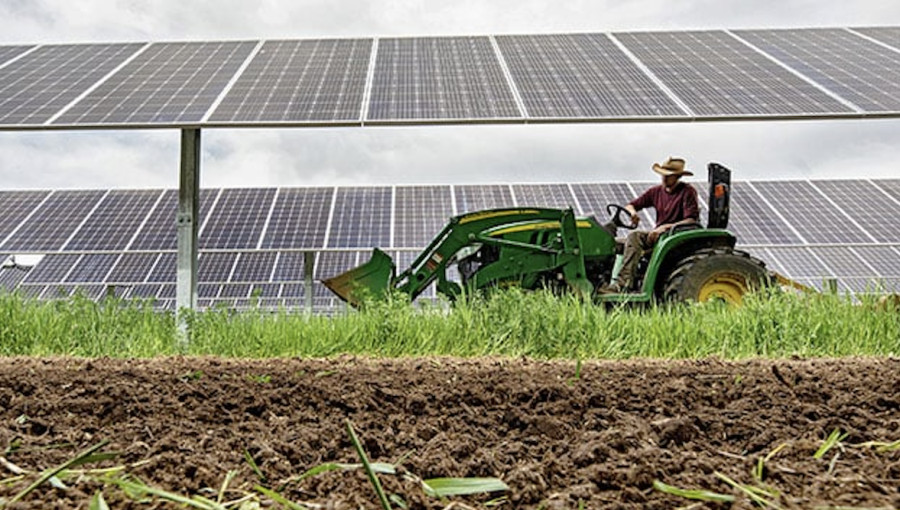
American farmers are increasingly turning to renewable energy as a vital financial lifeline amidst a worsening climate crisis and skyrocketing production costs. With extreme weather devastating traditional crop yields in states like Kansas and Oklahoma, land lease payments from wind and solar projects are providing the stability needed to keep family farms operational. Recent data indicates that rural renewable energy revenue is now rivaling major agricultural commodities, generating billions of dollars for local economies and funding essential public infrastructure.
Agriculture has become an increasingly volatile industry as farmers grapple with the dual pressures of climate change and rising overheads. In the U.S. “Wheat Belt,” spanning Kansas, Oklahoma, and Texas, record-breaking temperature extremes have decimated winter wheat harvests. Long-time producers report yields dropping from historic averages to levels insufficient to cover basic equipment and seed costs. Meteorologists attribute these unprecedented heatwaves to shifting climate patterns, noting that such extremes would be virtually impossible without global warming influences.
Beyond weather-related crop failures, the financial burden on small-scale operations is reaching a breaking point. High costs for fertilizers and fuel are squeezing profit margins, which for many family farms already sit below 10%. In New York, dairy farmers like Blake Gendebien, who manages a 485-hectare farm, report that diesel prices have nearly doubled in recent years. For an operation requiring approximately 75,700 liters of fuel annually, this price hike represents a $50,000 increase in expenses—a staggering blow to businesses with a gross income under $350,000.
In this precarious environment, renewable energy has emerged as a critical economic stabilizer. According to research from RMI, revenue from wind and solar projects in rural areas is approaching the scale of major agricultural commodities. In 2024, nine states generated over $1 billion each from renewable energy, totaling $23 billion nationwide. This income is particularly concentrated in top agricultural states, where farmers use land lease payments to offset the volatility of commodity prices and input costs.
While some local communities express concerns regarding the visual impact of a solar panel array or the loss of traditional farmland, data suggests a minimal footprint for many projects. A USDA study found that less than 1% of wind energy sites required a shift away from agricultural use, allowing farming to continue around the turbines. Although solar installations have a larger footprint, they offer a predictable, long-term revenue stream that often prevents the permanent sale of land for residential or commercial development.
The benefits extend beyond individual farms to the broader rural infrastructure. In Howard County, Iowa, wind projects contributed $2.7 million in tax revenue in 2024 alone, accounting for nearly 15% of the county’s total tax base. These funds are used to maintain roads, support local schools, and improve public services. As the U.S. prepares to site an estimated 90% of future solar infrastructure on rural land through 2050, these partnerships are becoming essential for the survival and modernization of the American farming landscape.
