
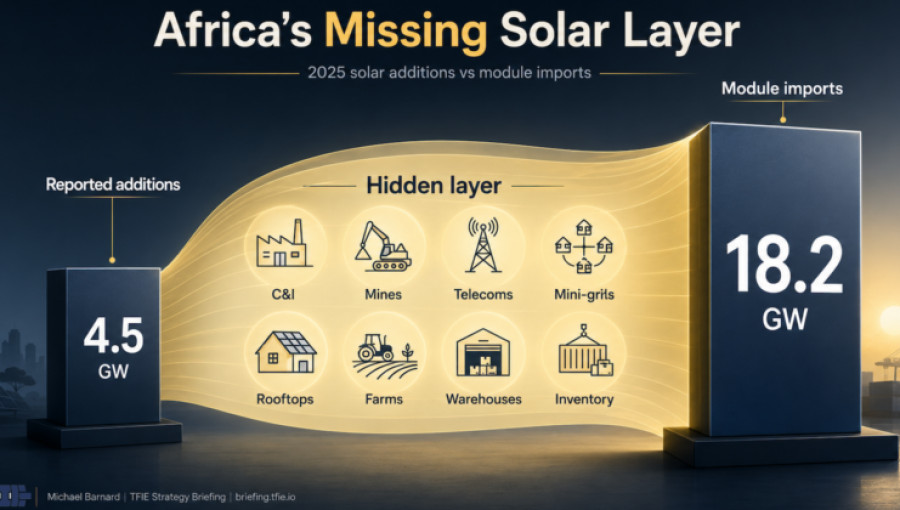
Africa’s solar energy expansion is currently obscured by a significant discrepancy between official installation reports and actual hardware imports. While formal data indicates that Africa added 4.5 GW of solar PV in 2025, the continent imported 18.2 GW of solar modules during the same period. This gap suggests that a massive, decentralized transition is underway, driven by mines, farms, and households seeking to bypass unreliable grids and reduce dependence on expensive diesel. Rather than relying on large-scale utility projects, this growth is occurring behind the meter, making it difficult for traditional statisticians to track accurately.
The surge in module imports is supported by a convergence of factors, including lower costs for Chinese-made solar hardware and battery storage, alongside improved logistics corridors. Unlike the centralized, grid-connected models seen in countries like India, Africa’s energy transition is highly fragmented. It is characterized by diverse applications, such as powering telecom sites, industrial facilities, and mini-grids. Because much of this activity happens outside of government-led auctions or formal commissioning reports, official capacity tables fail to capture the full scale of the continent’s solar adoption.
While it is unlikely that Africa will report 20 GW of official solar capacity additions in 2026, the physical absorption of 20 GW of solar modules across the economy remains a plausible outcome. The transition is moving faster than official reporting structures can accommodate, as private entities prioritize energy reliability and cost savings over grid-scale integration. Consequently, observers should look beyond official capacity figures and instead monitor hardware flows, inverter imports, and diesel displacement metrics to gain a more accurate understanding of the real-world progress of solar energy across the African continent.