
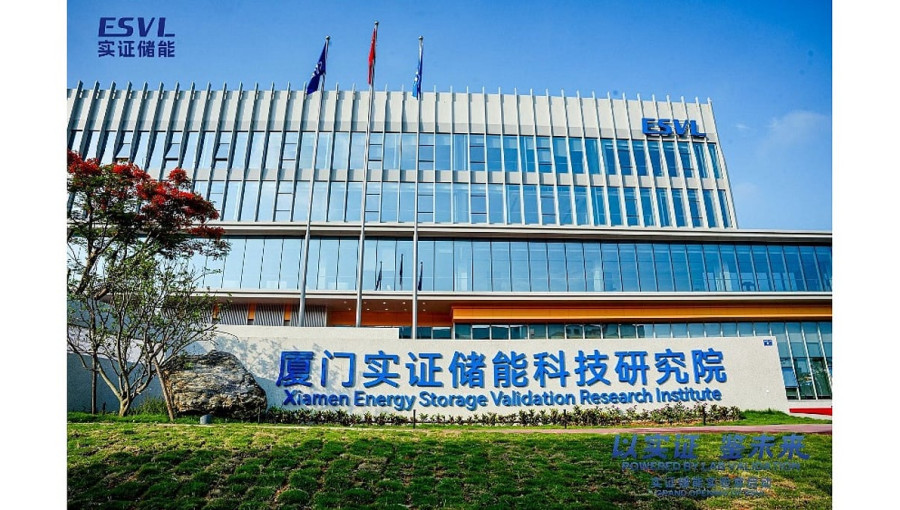
Contemporary Amperex Technology Co. Ltd. (CATL) has inaugurated the Xiamen Energy Storage Validation Research Institute (ESVL), a massive RMB 3 billion testing platform dedicated to large-scale energy storage systems. As the global energy storage market experiences rapid growth, this facility aims to set new benchmarks for safety, grid-support capabilities, and long-term reliability. By moving beyond component-level testing to full-system and station-level verification, the institute provides a rigorous environment for validating energy storage technology. The platform collaborates with international certification bodies to offer globally recognized services, ensuring that energy storage assets meet the high standards required for modern grid infrastructure.
The launch comes as the energy storage industry enters a period of significant expansion. According to Bloomberg New Energy Finance, global annual additions of energy storage—excluding pumped hydro—surpassed 100 GW in 2025, reaching 112 GW. This represents a 48% increase over the previous year, with 307 GWh of battery capacity added worldwide. CATL contributed 121 GWh to this total. Projections suggest this growth will continue, with annual additions expected to hit 158 GW in 2026 and climb to 308 GW by 2036, driven by falling costs, the rise of data centers, and increased electric vehicle charging demands.
To address these market needs, the ESVL features five specialized laboratories designed to simulate the most demanding grid conditions. The grid integration laboratory, which features a 35 kV/100 MVA grid simulator, is capable of testing over ten large-scale energy storage containers simultaneously. Other facilities include a high-voltage safety lab for investigating fire and explosion mechanisms, and a thermal safety and combustion lab equipped with a 20 MW calorimeter. Furthermore, the environment reliability laboratory tests systems against extreme temperatures and altitudes, while the electromagnetic compatibility laboratory is uniquely capable of performing tests on full 40-foot containers under high-power conditions.
By providing independent and traceable data, the institute intends to assist regulators, insurers, and financial institutions in assessing the credibility and risk of energy storage projects. Dr. Wu Kai, CATL’s Chief Scientist, emphasized that as the sector enters the gigawatt era, scientific rigor is essential for fostering a more trusted and sustainable industry. Dr. Chen Xiaobo, head of the ESVL, noted that this validation process is vital for establishing energy storage as a reliable, bankable asset within critical infrastructure, ultimately helping to raise quality standards across the entire pre-delivery stage of battery storage deployment.