
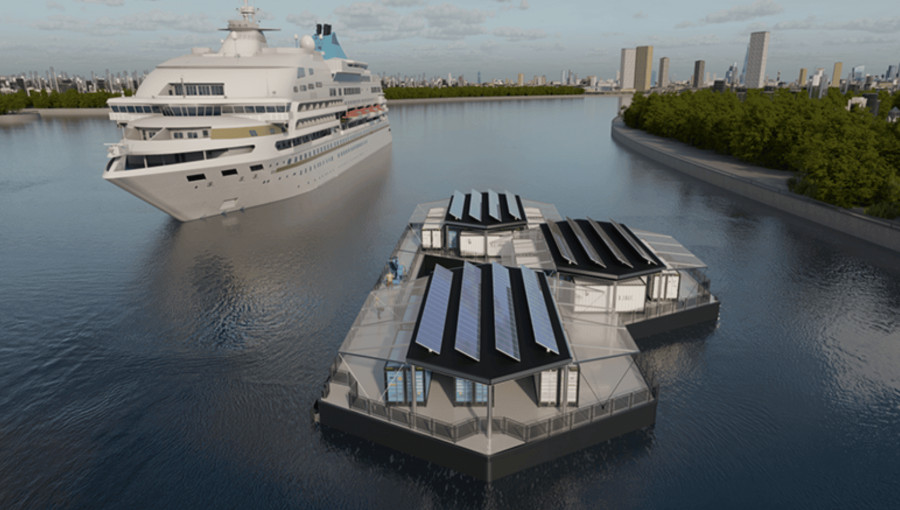
A novel floating hydrogen power hub has successfully completed a validation phase, offering a potential breakthrough for ports struggling to provide clean energy to large vessels. By bypassing the need for complex land-based electrical grid infrastructure, this modular system delivers power directly to ships at sea. The platform integrates hydrogen fuel cells, battery storage, and onboard solar panels to provide a consistent energy supply. Recent testing confirms the system’s stability and its ability to significantly reduce docking emissions, providing a flexible, portable alternative to traditional diesel generators while addressing the space and time constraints faced by modern ports.
The floating system occupies approximately 1,200 square meters across three connected platforms. It utilizes 1.3-megawatt hydrogen fuel cells that operate continuously, charging 45 megawatt-hours of onboard battery storage throughout the week. When a vessel docks, the stored energy is discharged to meet power demands. Onboard solar panels contribute an additional 146 kilowatts of power, further optimizing hydrogen consumption. This configuration is capable of delivering 5 megawatts of continuous clean energy, sufficient to support medium-sized cruise ships and other large maritime vessels, effectively replacing the need for high-emission diesel generators during port stays.
A six-month validation program conducted in the United Kingdom confirmed the viability of the technology. Researchers at the University of Strathclyde utilized wave tank testing to verify that the platform remains stable under various sea conditions, while mooring analysis indicated no significant technical obstacles to deployment. Data suggests that the system can reduce a vessel’s docking emissions by approximately 77% compared to conventional power sources. While the current cost of energy ranges from £0.25 to £0.50 per kilowatt-hour, the primary advantage lies in its rapid deployment capability and the flexibility to relocate the entire platform as port demands evolve.
ELIRE Maritime is currently exploring future implementation opportunities for the technology across the United Kingdom, Europe, and Australia. By eliminating the three-to-seven-year wait times often associated with building land-based grid infrastructure, this floating solution provides a scalable path for ports to transition toward cleaner operations. The ability to bypass land constraints while maintaining a reliable power supply positions this hydrogen-based hub as a significant development in maritime decarbonization, offering a practical response to the logistical challenges of providing shore power to large-scale shipping fleets.