
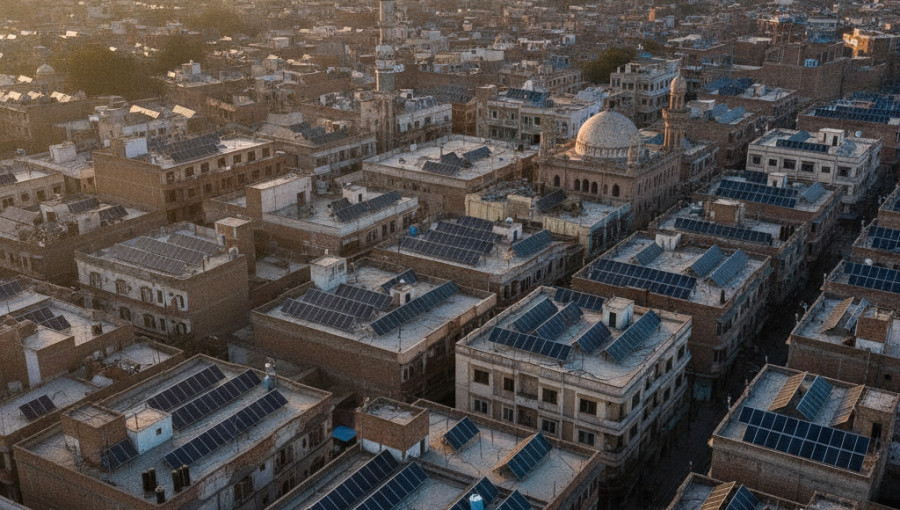
Pakistan has experienced an unprecedented, grassroots solar energy revolution, becoming the world’s second-largest importer of solar modules by 2025. Driven by frequent power outages and rising electricity costs rather than government incentives, millions of households and businesses have independently installed rooftop solar systems. This rapid, unplanned transition has made solar the country’s primary electricity source during peak months. However, this shift has triggered a “utility death spiral,” where the exodus of paying customers from the grid forces remaining users to shoulder higher costs, prompting regulators to pivot toward restrictive net-billing policies to stabilize the struggling energy sector.
The scale of this transition is visible from space, with satellite imagery confirming an exponential rise in rooftop solar installations between 2021 and 2025. Pakistan imported approximately 16.9 GW of solar panels in 2025 alone, contributing to a total of 55 GW over recent years. While official data often underestimates this growth due to the distributed, behind-the-meter nature of the installations, solar now accounts for roughly one-quarter of the nation’s electricity generation during peak periods. This surge was primarily fueled by private investment rather than state-led programs, marking a departure from traditional, top-down energy transitions seen in other nations.
The boom was largely a response to systemic grid failures. Pakistan has long struggled with “load-shedding,” where rural areas face up to 20 hours of daily outages. Despite having a surplus of generating capacity, the power sector is burdened by massive “circular debt” caused by unpaid subsidies and expensive capacity payments to private power producers. As electricity tariffs tripled over the last decade, consumers turned to affordable, imported solar modules to secure energy independence. For many, a rooftop system offers a reliable alternative to a failing grid, with payback periods often spanning only two to three years.
This rapid, unmanaged shift presents significant challenges for the country’s infrastructure. As wealthier consumers install solar and reduce their reliance on the grid, the fixed costs of maintaining the national power system are redistributed among a shrinking base of users, leading to higher bills and further incentivizing the move to solar. In response, the regulator, NEPRA, replaced net-metering with a net-billing system in 2026, significantly reducing the credit solar owners receive for excess power. While this move aims to protect the financial viability of the grid, it highlights the tension between individual energy autonomy and the collective need for stable, shared infrastructure.
Ultimately, Pakistan’s experience serves as both a model for rapid renewable deployment and a cautionary tale regarding institutional readiness. While distributed solar has provided a vital lifeline for those facing energy poverty and unreliable supply, the country’s struggle demonstrates that technological adoption must be accompanied by updated market designs and policy frameworks. As other developing nations face similar energy challenges, Pakistan’s trajectory shows that while private investment can drive a solar revolution, the long-term success of such a transition depends on how governments manage the integration of millions of independent power producers into the existing grid.