
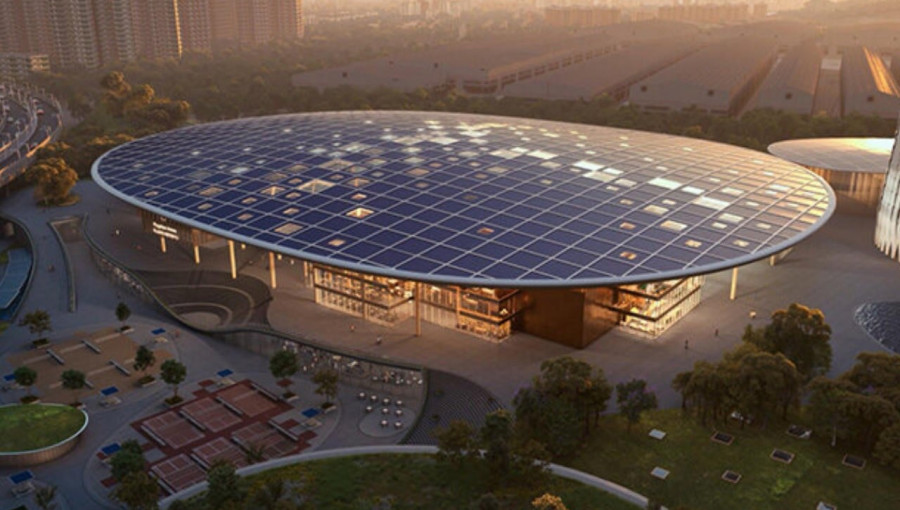
Solar technology is undergoing a significant aesthetic transformation, moving away from utilitarian, rigid grids toward expressive, sculptural forms. For decades, solar panels were treated as secondary technical additions, often hidden from view due to their stark appearance. Today, architects and designers are integrating advanced photovoltaics into the built environment as intentional, artistic landmarks. By utilizing flexible thin-film cells and organic photovoltaics, creators are turning renewable energy systems into fluid, visually engaging structures that serve as both functional power generators and cultural centerpieces, effectively bridging the gap between sustainability goals and architectural harmony.
This shift is evident in major projects like the Sweet Spot sports complex in Shenzhen. Designed by MVRDV and Huayi Design, the facility features a massive rooftop shaped like a badminton racket, where integrated photovoltaic panels provide clean energy while defining the building’s iconic silhouette. Similarly, designers are increasingly drawing inspiration from nature to create solar “trees” and canopies. The Ecacia structure by Samuel Wilkinson, for instance, mimics the form of an African acacia tree, using 708 monocrystalline solar panels to provide shade and power for public amenities, proving that infrastructure can be both durable and aesthetically pleasing.
Beyond static installations, innovation is expanding into textile-based energy solutions and hybrid systems. Pauline van Dongen’s Umbra Pavilion utilizes a sky-blue fabric embedded with organic photovoltaic cells, demonstrating how solar technology can be woven into flexible, lightweight materials for façades and public spaces. Meanwhile, the Aeroleaf Hybrid combines wind and solar power into a tree-like design, offering a compact, quiet energy solution for urban environments. By incorporating interactive lighting and smart-city features like device charging, these solar sculptures are becoming valued community assets that turn the abstract process of energy generation into a visible, shared, and celebrated experience.