Barbados Leads Caribbean In Wave Energy And Desalination
Barbados is set to become a Caribbean leader in marine renewables through a new partnership with Danish engineering firm Wavepiston. The collaboration, formalized through a Memorandum of Understanding with the government agency Export Barbados, aims to develop a 50-megawatt wave energy project that simultaneously generates clean electricity and desalinated drinking water. This flagship initiative represents a critical transition from feasibility studies to commercial-scale development, supporting the island nation's ambitious goal of reaching net-zero emissions by 2030 while significantly enhancing its regional energy and water security.
The agreement follows an extensive pre-feasibility study conducted on the island, marking a pivotal shift toward the practical deployment of Wavepiston’s proprietary technology. Unlike traditional renewables, this system harnesses the kinetic energy of ocean waves, which offers a more consistent and predictable power supply than solar or wind energy. The project is designed to serve as a regional "lighthouse," demonstrating the technical and financial viability of wave-based solutions for island nations facing high energy costs and climate-related water scarcity.
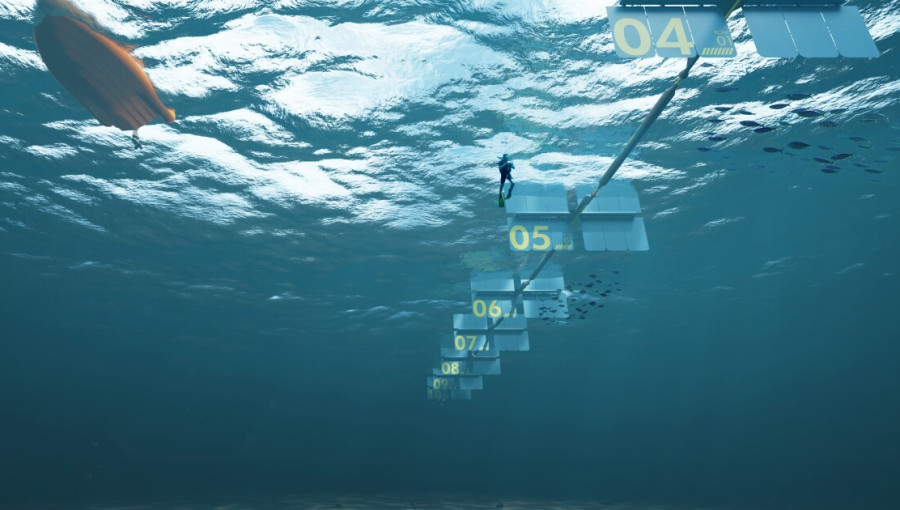
The technology utilizes a modular offshore configuration consisting of flexible strings approximately 350 meters long. These strings are anchored to the seabed and equipped with multiple energy collectors. As waves pass, underwater sails on each collector move back and forth, driving integrated hydraulic pumps that pressurize seawater. This high-pressure water is transported via pipelines to a conversion station—located either on the coast or further out at sea—where it is used to power hydropower turbines for electricity or processed through reverse osmosis systems to create fresh drinking water.
One of the system's primary advantages is its robust and scalable design. By spacing collectors along the string, the device produces a steady flow of pressurized water rather than the intermittent surges typical of many wave energy devices. This arrangement also facilitates a force-cancelling effect, which minimizes mechanical stress on the mooring system and allows for a lighter, more cost-effective structure. The modular nature of the equipment means installations can be tailored to specific community needs, ranging from small-scale setups to massive wave energy farms comprising hundreds of strings.
Environmental sustainability remains a core focus of the initiative. Extensive testing has indicated that the installations do not negatively impact marine ecosystems; in some instances, the structures have even fostered increased biodiversity by acting as artificial reefs. For Barbados, which has already invested heavily in solar panel arrays and battery storage, this project represents the next step in its comprehensive green transition. Beyond environmental benefits, the partnership is expected to create local jobs and establish the country as a specialized hub for marine energy expertise throughout the Caribbean.