
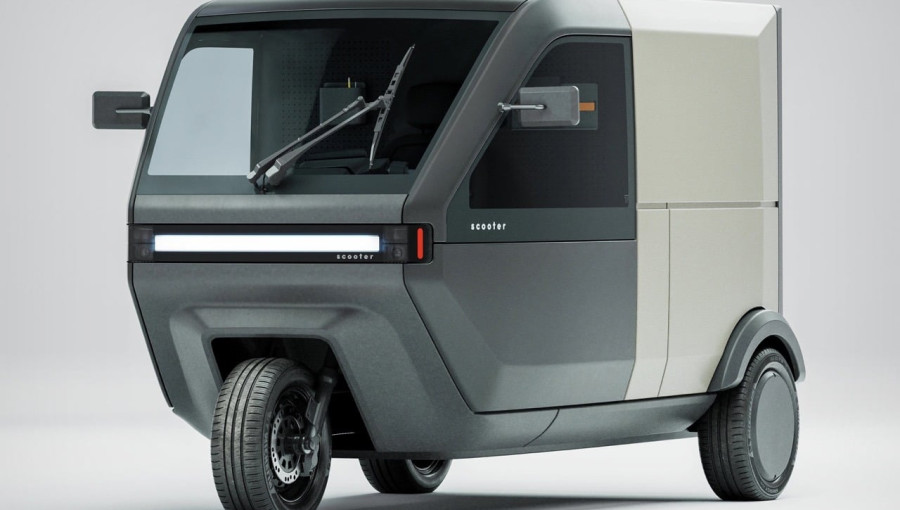
Belgian designers Jeroen Claus and Fabian Breës have unveiled the Scooter P-Two, a Cybertruck-inspired electric trike designed to revolutionize urban logistics. Developed under the Voyager brand, this modular three-wheeler addresses the “last-mile” delivery challenge in dense city centers where traditional vans struggle. Featuring an enclosed cabin and a versatile cargo area with a space-saving roll-up door, the P-Two blends the agility of a scooter with the utility of a light commercial vehicle. Its geometric aesthetic and compact footprint aim to provide a practical, weather-protected solution for couriers and small businesses.
Three-wheeled vehicles have long occupied a unique niche in transportation, often caught between the size of a bicycle and the presence of a traditional car. While the tuk-tuk remains a staple in Southeast Asia and the Piaggio Ape dominates narrow European streets, the Scooter P-Two represents a modern, electrified evolution of this form factor. By focusing on the specific constraints of dense urban environments, the Voyager concept aims to solve practical problems that larger electric vehicle manufacturers have largely overlooked.
The design language of the P-Two draws clear inspiration from the angular, minimalist aesthetic popularized by the Tesla Cybertruck and Rivian. A prominent horizontal light bar spans the front fascia, complemented by a vertical red accent that provides visual definition. The vehicle utilizes a two-tone charcoal and off-white color scheme, which effectively breaks up its volume to make the structure appear lighter and more sophisticated. Despite its compact exterior dimensions, the interior architecture is optimized for maximum volume, utilizing large glass surfaces to maintain visibility and a sense of openness.
Functionality sits at the core of the P-Two’s design, particularly regarding its cargo management. Instead of traditional hinged or sliding doors, which can be cumbersome in tight alleyways, the vehicle features a rear roll-up shutter. This mechanism allows for full access to the cargo hold without requiring extra clearance, making it ideal for rapid loading and unloading. The modular platform is designed to be highly adaptable, with configurations available for package delivery, mobile retail, or even passenger transport.
From a mechanical perspective, the trike layout offers distinct advantages for city navigation. The P-Two is narrow enough to perform lane-filtering in heavy traffic, a feat impossible for standard delivery vans. Unlike many micro-mobility solutions that use thin, fragile tires, the P-Two utilizes conventional tire sizing on its exposed front wheel to ensure stability and confident braking on uneven pavement. This setup provides a planted feel while maintaining a footprint that can access areas restricted to larger automobiles.
While the industry often focuses on autonomous ride-hailing for personal travel, the P-Two targets the essential “last-mile” logistics that keep cities running. From grocery deliveries to mobile coffee vendors, the vehicle provides the weather protection and hauling capacity required for commercial use without the high overhead of a full-sized electric truck. By prioritizing urban movement patterns over theoretical performance metrics, Voyager has created a concept that bridges the gap between a simple scooter and a heavy-duty delivery vehicle.