Economics Not Physics Limit Long Term Battery Storage
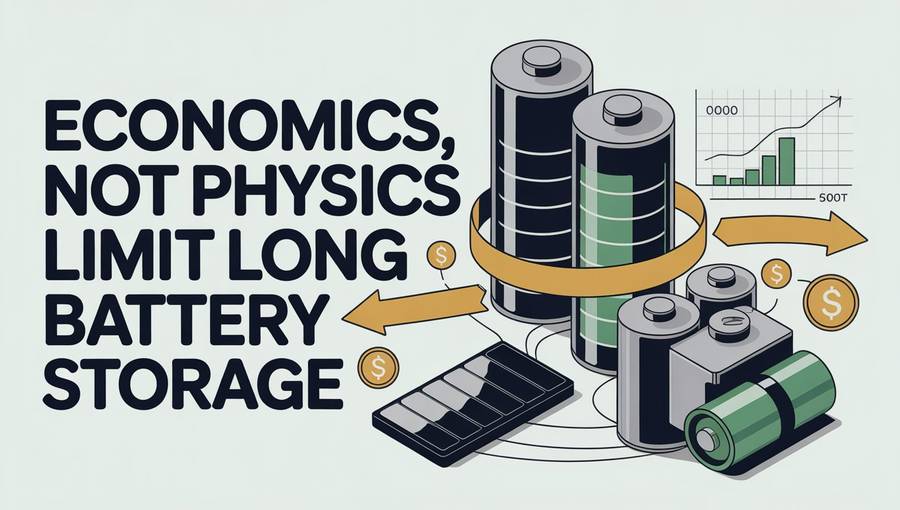
While lithium-ion batteries are technically capable of holding a charge for months, their practical use is limited by the economics of energy storage rather than physical capacity. For a storage system to be financially viable, the initial capital cost must be distributed over as many kilowatt-hours as possible throughout its lifespan. This economic reality favors frequent, daily cycling—such as storing power from a solar panel for use at night—while making long-term or seasonal storage prohibitively expensive. As the energy transition progresses, understanding these financial constraints is vital for developing realistic solutions for grid stability.
The common belief that batteries cannot store energy for more than four hours is a misunderstanding of industry standards. Technically, a lithium-ion battery, specifically those using LFP (lithium iron phosphate) chemistry, experiences a self-discharge rate of only 1% to 5% per month. The limitation is entirely financial; the "use it or lose it" nature of battery degradation means that a battery sitting idle is losing value. All solar module systems paired with storage must account for both cycle life—the number of times a battery can be charged—and calendar life, which is the natural degradation of the battery over time regardless of use.
To illustrate the economic hurdle, consider a storage system with a capital cost of $100 per kWh. If this system is cycled daily, the cost of the stored energy is roughly $0.02 per kWh over its 16-year lifespan. However, if that same battery is used for seasonal storage—cycled only once a month to cover periods of low production—the cost skyrockets to approximately $0.51 per kWh. This massive increase occurs because the initial investment is spread over far fewer units of energy, making the electricity delivered to the grid significantly more expensive than traditional sources.
This economic pressure dictates which technologies succeed in different sectors. For instance, short-distance ferries are ideal candidates for electrification because they can cycle their batteries multiple times a day. Conversely, transoceanic shipping remains a challenge; because a vessel may take over a month to cross the Pacific, the capital cost of the batteries would be amortized over too few cycles to be affordable. Similarly, while hydrogen is often proposed for long-term storage, its low round-trip efficiency of approximately 37% and high infrastructure costs make it a difficult sell compared to other emerging technologies.
Other storage alternatives, such as flow batteries and iron-air systems, attempt to decouple power capacity from energy storage to lower costs. However, vanadium redox flow batteries currently struggle to compete with the falling prices of LFP solar cell applications. Iron-air batteries, which utilize the reversible oxidation of iron, offer a lower-cost potential but must overcome significant efficiency losses and high self-discharge rates to become a staple of the energy market.
For managing the "dunkelflaute"—extended periods of cold, dark, and calm weather where wind and solar panel output drops—experts suggest that batteries may never be the primary solution. Instead, the most cost-effective strategy involves overbuilding renewable capacity and repurposing existing natural gas infrastructure to store biofuels or biogas. These stored fuels can be utilized in low-capital-cost gas turbines during emergencies, providing a reliable backup without the massive upfront investment required by a month-long battery array. This approach minimizes CO2 emission levels while maintaining grid reliability during the most challenging weather conditions.