
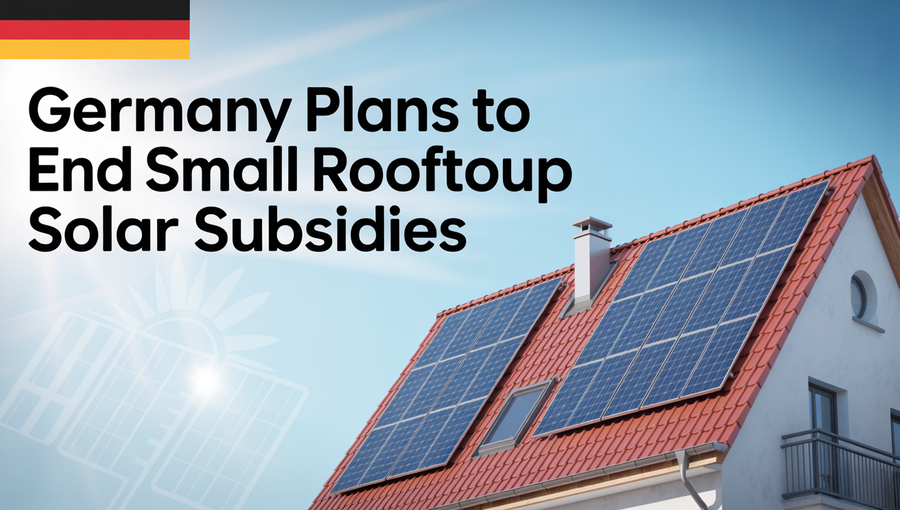
Germany’s Ministry for Economic Affairs is reportedly drafting a reform to the Renewable Energy Act (EEG) that would eliminate guaranteed financial support for small-scale rooftop solar installations. The proposal targets private systems with a capacity of up to 25 kilowatts, arguing that falling installation costs and high self-consumption rates have made these projects independently profitable. While the government emphasizes cost efficiency and grid stability, industry advocates and environmental groups warn that the move could jeopardize thousands of jobs and significantly hinder the nation’s transition to clean energy.
According to leaked documents reported by ntv, the economy ministry, led by Katherina Reiche, plans to exclude small residential solar panels from the long-standing feed-in remuneration scheme. The logic behind the shift is that public subsidies are no longer necessary for smaller installations as they already offer a solid return on investment. A ministry spokesperson noted that prior policies often overlooked supply security and cost-effectiveness, leading to taxpayers funding projects that could survive on market terms alone. Furthermore, the rapid expansion of solar power capacity is cited as a growing challenge for grid management and system integration.
The Renewable Energy Federation (BEE) has reacted sharply to the news, describing the potential cuts as a direct assault on the green energy sector. BEE head Ursula Heinen-Esser cautioned that the proposed measures, which also include a requirement for mandatory direct marketing of generated electricity, would have disastrous consequences for public participation in the energy transition. She argued that these changes contradict the government’s stated goal of expanding renewable capacity and could undermine the resilience of the German economy.
Industry association BSW Solar echoed these concerns, warning that the reform could lead to the loss of tens of thousands of jobs and put national CO2 emission targets out of reach. Carsten Körnig, head of the association, stated that guaranteed remuneration remains a vital pillar for the economic viability of private solar module installations. He also pointed out that the infrastructure for mandatory direct marketing, such as advanced smart metering systems, is currently insufficient to support such a transition for small-scale operators.
The opposition Green Party has linked the proposed solar cuts to broader concerns regarding heating energy regulations. Critics argue that the government’s shift away from mandatory renewable shares in heating systems, combined with the end of solar subsidies, creates a double burden for consumers. Green parliamentary leader Katharina Dröge noted that these policies could lead to soaring heating costs while simultaneously penalizing homeowners who invest in sustainable technology.
Since taking office in May 2025, Minister Reiche has prioritized restructuring the renewable energy support system to manage expansion speeds and protect the power grid. While the ministry maintains that these steps are essential for long-term stability and cost control, opponents argue that the measures will slow the roll-out of clean energy and allow fossil fuel business models to persist longer than necessary.