Hybrid Renewables Now Cheaper Than Fossil Fuels
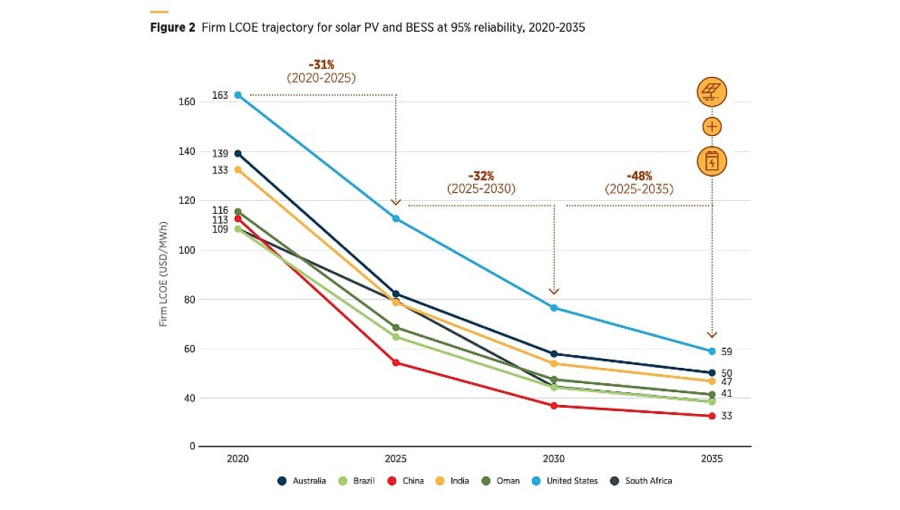
A comprehensive analysis by the International Renewable Energy Agency (IRENA) indicates that hybrid renewable systems combined with battery storage have reached a price point competitive with traditional fossil fuel generation. These 24/7 power solutions, now costing between $54 and $82 per megawatt-hour (MWh), are increasingly cheaper than new coal or gas facilities in most global markets. As technological advancements continue, costs are expected to fall by an additional 40% by 2035. This shift provides a rapid, resilient alternative to meet the growing electricity demands of heavy industry and the burgeoning artificial intelligence sector.
According to the IRENA report, titled "24/7 Renewables: The Economics of Firm Solar and Wind," the combination of solar and wind resources with advanced storage technology can now deliver consistent, round-the-clock electricity. In regions with high solar irradiance, the cost of firm solar-plus-storage has plummeted from over $100/MWh in 2020 to its current competitive range. This compares favorably against new coal projects in China, which cost between $70 and $85/MWh, and new gas-fired plants globally, which frequently exceed $100/MWh.
The dramatic shift in energy economics is the result of a decade of steep price declines across the renewable sector. Since 2010, the installation costs for a solar panel or solar module have dropped by 87%, while onshore wind costs fell by 55%. Most significantly, battery storage costs have seen a 93% reduction, enabling the "firming" of intermittent renewable sources. By co-locating these technologies, developers can balance generation profiles and minimize the amount of storage required, further driving down overall system expenses.
Looking ahead, IRENA projects that the cost of firm renewable electricity will continue its downward trajectory, potentially decreasing by 30% by 2030 and 40% by 2035. Many global projects are expected to deliver power for less than $50/MWh within the next decade. While most international markets will see costs between $44 and $58/MWh, the United States may face slightly higher prices due to complex permitting processes, interconnection charges, and financing hurdles.
Practical applications of these 24/7 systems are already emerging worldwide. The Al Dhafra complex in the UAE is designed to provide 1 GW of firm clean electricity at approximately $70/MWh by pairing solar PV with battery storage. Similar trends are visible in India’s round-the-clock renewable tenders and the increasing popularity of solar-plus-storage facilities in Australia, Portugal, and the United States. Recent studies even suggest that integrated solar and storage could reduce power costs in the European Union by nearly half by 2030.
Beyond cost-effectiveness, the speed of deployment offers a significant advantage over traditional energy infrastructure. Renewable-plus-storage projects can typically be completed within one to two years once permits are secured, significantly faster than the timeline required for new fossil fuel plants. This rapid scalability is critical as the expansion of data centers and the electrification of industry drive a surge in global power demand.
IRENA Director-General Francesco La Camera emphasized that the "battery revolution" has fundamentally altered the energy landscape, making renewables a reliable and resilient choice. He noted that moving toward these hybrid systems helps insulate national economies from the volatility of oil and gas markets and geopolitical disruptions. To fully realize these benefits, however, the agency stresses that governments must prioritize supportive policies, market reforms, and proactive grid planning to integrate firm renewable energy effectively.