Innovative Floating Solar Farm Design Inspired by Spider Webs

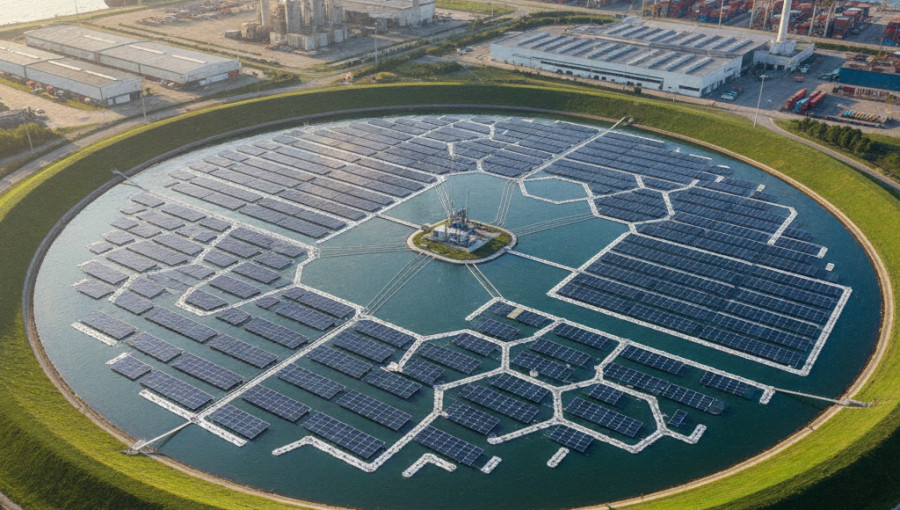
Researchers from the University of Strathclyde in Scotland have introduced an innovative floating photovoltaic (PV) farm design inspired by the structure of spider webs. This new concept is optimized for use in circular and radial patterns, making it potentially effective for installation alongside offshore wind farms. Employing a web-like framework, the system aims to be both cost-effective and resilient to environmental challenges by mimicking the elasticity and durability of natural spider webs.
The proposed floating PV system utilizes a unique web structure that comprises both spiral and radial lines, allowing it to shift with the waves while maintaining structural integrity. By placing the floating modules between offshore wind turbines, the web frame is reinforced, enhancing stability. The PV arrays are arranged in squares, and flexible ropes play a key role in construction, enabling the entire assembly to absorb wave energy through elastic deformation.
In their analysis, the research team utilized the Morison model, a standard technique for evaluating wave forces on offshore structures, alongside the Riflex simulation tool to study load distributions. They tested various configurations of PV modules to understand how different designs would perform under various wave conditions. Their findings indicate that the overall motion phase of the modules is more critical than the wave amplitude, leading to harmonious movement that minimizes stress on the system and enhances its resilience against harsh maritime conditions.
Though still in the conceptual stage, the Strathclyde team aims to advance this floating PV technology towards commercial viability. Collaborations with academic and industrial partners throughout Europe are underway to secure funding for further development, with aspirations to elevate the technology's readiness level within the next three years.