Innovative Vertical Solar Trees Power Alpine Ski Resorts
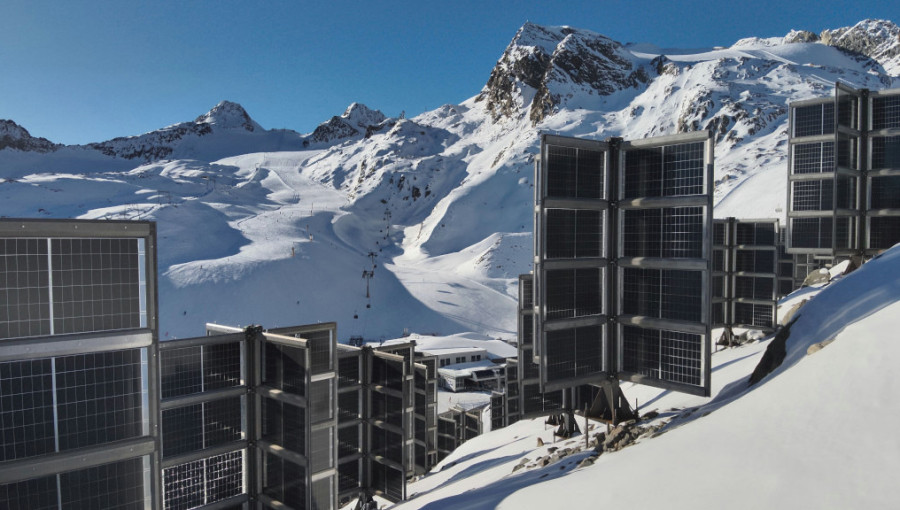
Innovative vertical solar "trees" are being deployed in the Tyrolean Alps to provide clean energy for high-altitude ski resorts. Developed by Helioplant in collaboration with SolarEdge, these unique cross-shaped installations prevent snow accumulation while maximizing energy yield through bifacial solar module technology. Located in Sölden at altitudes reaching 3,000 meters, the project will consist of 800 structures with a total capacity of 6.3 megawatts. Once completed in 2026, the facility will supply approximately one-third of the annual electricity required by three major regional ski resorts, significantly reducing their carbon footprint.
In the Ötztal valley of Tyrol, Innsbruck-based system provider Helioplant is revolutionizing alpine energy production with a distinctive vertical solar array. In partnership with SolarEdge, the company is installing bifacial solar modules on specialized, cross-shaped substructures. Each unit resembles a tree, featuring a central column supporting four independent wings that hold between 15 and 16 modules. This vertical orientation is specifically designed to handle the extreme weather conditions characteristic of high-altitude environments.
The tree-like design offers significant mechanical advantages over traditional solar panel rows. Because the modules are positioned vertically, snow cannot settle on the surfaces. The cross formation also generates natural air turbulence, even in light winds, which prevents snow drifts from accumulating on the structure. Furthermore, the installation benefits from the albedo effect; a natural crater forms in the snow around the base of the columns, reflecting sunlight onto the rear of the bifacial modules to boost overall energy output. Beyond its technical merits, the design is intended to integrate aesthetically into the mountainous landscape.
While the vertical arrangement is efficient for snow management, it does present challenges regarding module shading. To mitigate this, Helioplant utilizes SolarEdge technology, equipping each solar module with an individual power optimizer. This ensures that every module operates at its peak capacity independently. This configuration prevents the lower performance of a shaded module from affecting the output of the entire string, which is crucial in alpine settings where light reflection from snow-covered surfaces can be highly uneven and unpredictable.
The project follows a successful pilot phase conducted in 2023. A test installation consisting of twelve structures was built at 2,850 meters near the Tiefenbach Glacier. Throughout the winter season, the system reliably powered a ski lift, demonstrating its ability to reduce dependence on expensive grid electricity in remote areas. The success of this trial has paved the way for the current large-scale commercial expansion.
Construction is now underway for approximately 800 of these solar structures between 2,850 and 3,000 meters above sea level. With a total capacity of 6.3 megawatts, the completed plant is expected to be fully operational by the second half of 2026. It will provide clean power for three major ski resorts, covering roughly one-third of their combined 28-gigawatt-hour annual energy demand. This renewable energy will support essential operations, including cable car systems, hospitality services, and snowmaking.