Renewable Energy Savings Fail To Reach Household Bills
Recent data from European and US energy markets reveals a complex relationship between renewable energy and electricity costs. While a higher share of wind and solar successfully drives down wholesale prices by reducing dependence on expensive natural gas, these savings rarely reach household retail bills. This disconnect is caused by high taxes, policy levies, and rising system integration costs. Experts argue that for the energy transition to become affordable, governments must reform retail pricing structures and accelerate grid investments to support widespread electrification.
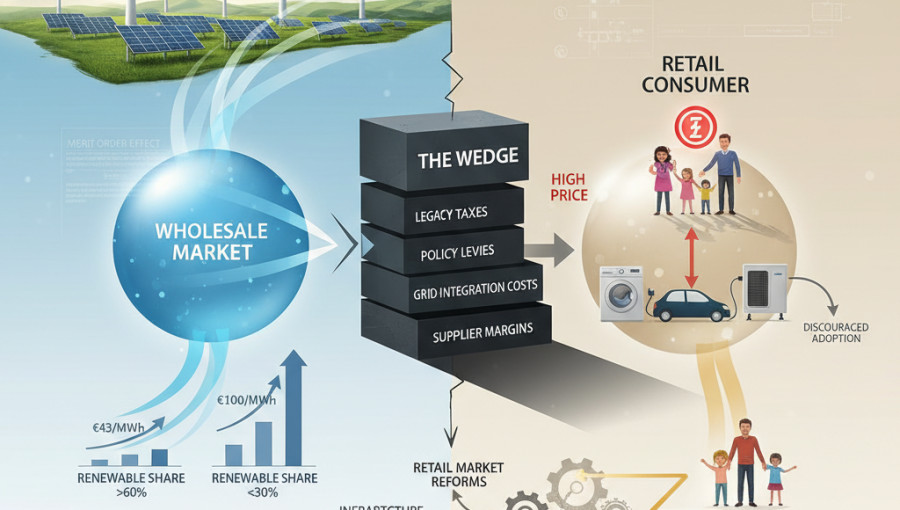
Analysis of European wholesale markets in early 2026 indicates a clear negative correlation between renewable energy shares and market prices. Countries like Spain and Portugal, where renewables exceed 60% of the mix, enjoy wholesale prices around €43/MWh. Conversely, nations with low renewable adoption, such as Poland and Czechia, face prices exceeding €100/MWh. The primary driver of high costs remains the frequency with which natural gas sets the marginal price. As more non-fossil capacity—including solar panels, wind, and storage—enters the grid, the influence of gas diminishes, leading to lower wholesale benchmarks.
Despite lower wholesale costs, household retail prices do not follow the same downward trend. In 2024 and 2025, there was no significant correlation between a country's renewable share and what residents paid. For instance, while Norway benefits from cheap electricity due to its 99% renewable share, Denmark maintains high prices despite a 91% share. This "wedge" between wholesale and retail is largely composed of network charges, supplier margins, and environmental levies. In many European regions, electricity is taxed significantly higher than gas, creating a price signal that inadvertently discourages consumers from switching to cleaner technologies.
As the share of variable renewables grows, system costs—including balancing services and grid reinforcements—are rising. In 2024, Germany spent €2.8 billion on curtailment compensation, while the UK’s balancing costs remained high. However, these expenses are often a symptom of lagging infrastructure rather than a flaw in renewable technology. Experts suggest that these costs are manageable if investments in transmission and storage keep pace with generation. Furthermore, as electrification increases through heat pumps and EVs, fixed grid costs can be spread across a larger volume of sales, potentially lowering the per-unit cost for all users.
The future of affordable energy depends on structural retail reform. To ensure the benefits of low-cost solar modules and wind turbines reach the public, policymakers are urged to rebalance levies across all fuel types. By shifting the financial burden away from electricity and toward fossil fuels, governments can incentivize the transition. The goal is to move toward a system where falling generation costs are not offset by inefficient tax designs, allowing the natural price advantages of renewables to finally reflect in consumer bank accounts.
https://janrosenow.substack.com/p/do-renewables-make-electricity-cheaper