
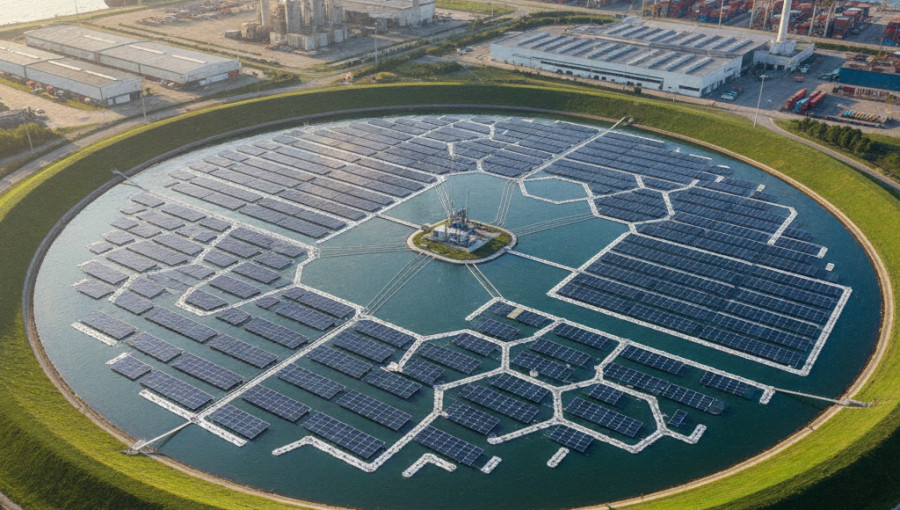
The Port of Rotterdam is moving forward with a massive 96 MW floating solar installation at the De Slufter dredging depot. Developed by the Sun Float Power consortium, the project aims to generate approximately 87 GWh of clean energy annually by 2027. Uniquely, the array will bypass the congested national grid to provide power directly to local industrial consumers. Spanning 80 hectares, the facility will become one of Europe’s largest floating photovoltaic systems, supporting the Dutch government’s initiative to repurpose state-owned land for sustainable energy production and significantly reducing regional carbon footprints.
A consortium of Dutch and German companies, operating under the name Sun Float Power, has been selected to develop, construct, and manage the ambitious project. The group includes DevCap Infra BV, Solinoor BV, and Enerparc AG. The chosen site, De Slufter, is a specialized facility for contaminated dredged materials located within the Maasvlakte extension of the port. Construction is expected to cover roughly 80 hectares of the water surface, utilizing space that otherwise serves limited industrial purposes.
Once fully operational, the floating solar plant is projected to produce enough electricity to power the equivalent of 30,000 homes. However, instead of feeding into the public network, the energy will be diverted to nearby businesses. This strategic decision addresses the region’s current grid congestion issues, ensuring that the new capacity provides immediate local value without overtaxing existing infrastructure. Port authorities noted that this creates direct added value for the industrial zone while maintaining stability for the national energy market.
Despite its significant scale, the installation will remain largely invisible to the public. The dredging depot is surrounded by a high ring dike that conceals the water surface from the surrounding landscape, ensuring the floating solar farm does not disrupt the visual aesthetics of the area. Public engagement remains a priority for the developers, who have scheduled informational sessions at the site’s offices to discuss technical specifications and the project timeline with local stakeholders.
The Rotterdam project reflects a growing trend in the Netherlands toward floating solar technology. Analysts from Wood Mackenzie predict the country could reach a total capacity of 1 GW in this sector by 2033. While the 96 MW site will be a significant addition to Europe’s renewable portfolio, it joins other major developments across the continent, such as a recently completed 74.3 MW array in France and a planned 140 MW facility in Slovenia, as Europe continues to expand its inland water solar capabilities.