Sweden Repurposes Wind Turbine Blades For Garage Facade
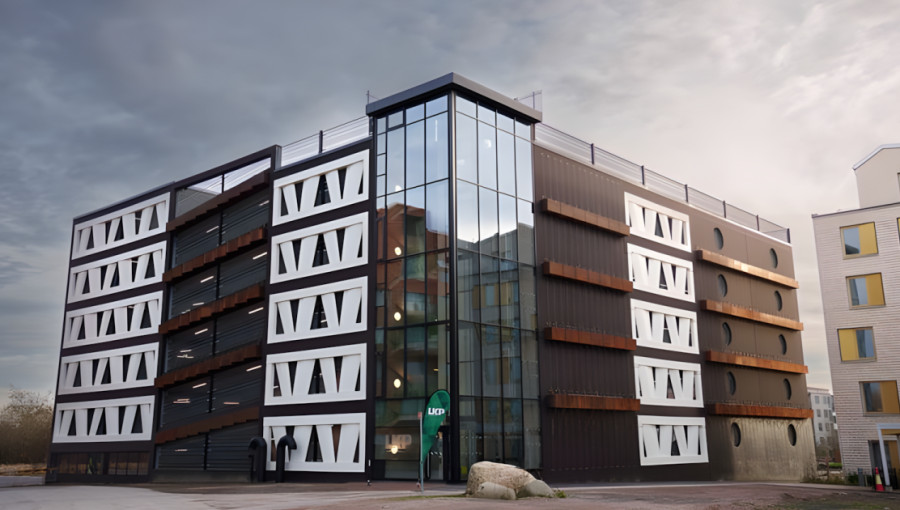
In Lund, Sweden, a new parking garage is demonstrating a groundbreaking approach to sustainable construction by using decommissioned wind turbine blades as its facade. The Niels Bohr parking garage, designed by architect Jonas Lloyd, tackles the significant environmental challenge of recycling old rotor blades, which are typically sent to landfills. In a partnership with energy company Vattenfall, 57 retired blades were repurposed as decorative curtain walls for the building, transforming industrial waste into a striking architectural feature and a symbol of circular economy principles in action.
As the global shift toward renewable energy accelerates, the disposal of old infrastructure, such as wind turbines, presents a growing concern. The rotor blades, engineered from highly durable composite materials like glass and carbon fiber to endure decades of extreme weather, are notoriously difficult to recycle. A creative solution in Sweden, however, is providing a second life for these components. This innovative project repurposed them not as scrap, but as a primary building material for a public structure, showcasing a novel way to upcycle industrial byproducts.
The concept for the Niels Bohr parking garage emerged when architect Jonas Lloyd of Lloyd's Arkitektkontor was commissioned for the project in Lund's burgeoning Brunnshög district. Inspired by an article detailing the recycling challenges faced by the wind industry, Lloyd proposed integrating the blades into the building's design. The green energy giant Vattenfall embraced the idea, donating the 57 decommissioned blades. These massive components were then meticulously cut to size and mounted onto the exterior, forming the building's distinctive, non-load-bearing curtain walls.
The five-story structure provides 365 parking spaces and is equipped with modern sustainable features, including 40 charging points for electric vehicles and an on-site battery for energy storage. To complement the industrial aesthetic of the blades, the facade also incorporates planters with local greenery, which will grow over time to soften the building's appearance. Architect Jonas Lloyd hopes the project serves as an "eye-opener," inspiring developers and designers to think differently about construction materials and what can be achieved with industrial waste.