
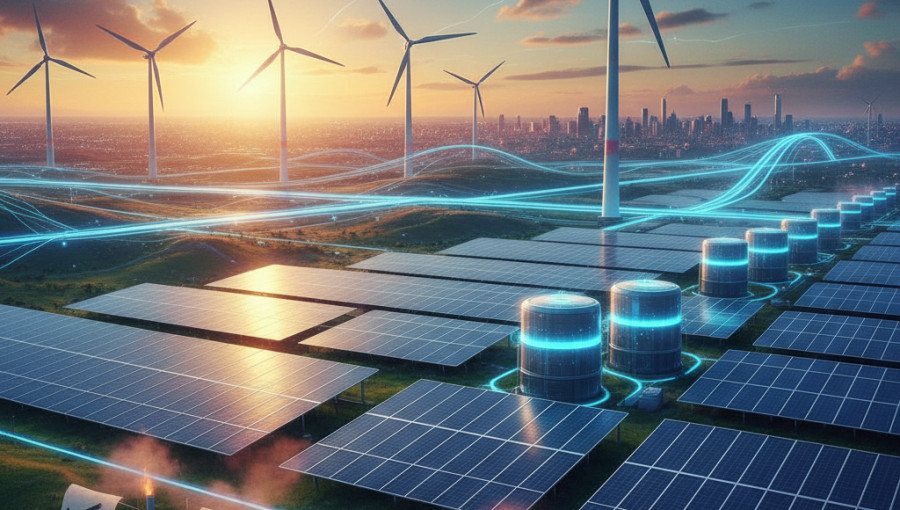
Despite a political environment favoring fossil fuels, clean energy has overwhelmingly dominated the expansion of the U.S. power grid in 2025. Data through November reveals that renewable sources and battery storage accounted for 92 percent of all new electricity-generating capacity added this year. This robust growth continues despite the current administration’s efforts to promote coal and natural gas, highlighting the strong economic and logistical momentum of solar and wind power in meeting the nation’s rising energy demands.
Analysis of U.S. Energy Information Administration data shows that through the first eleven months of the year, solar, wind, and energy storage projects represented the vast majority of new capacity. This figure is consistent with recent trends, closely following the 96 percent share that carbon-free sources held in 2024. Solar energy has been the single largest contributor in 2025, making up half of all new capacity, while battery storage projects accounted for a significant 31 percent.
The data presents a stark contrast to the administration’s stated policy goals. Even with strong rhetorical support for fossil fuels, newly installed wind power has contributed more gigawatts to the grid this year than new natural gas turbines. The continued expansion of renewables underscores market forces driving the energy transition, even in the face of political headwinds aimed at reviving fossil fuel industries.
It is important to note that these figures are preliminary. December is historically the most active month for commissioning new energy projects, so the final year-end numbers may shift. Furthermore, some of the current momentum could be attributed to developers accelerating project timelines to qualify for lucrative tax credits before potential new restrictions take effect. While fossil fuels still generate the majority of total U.S. electricity, the gap is steadily closing as new renewable capacity comes online.
Energy experts warn that any policy success in slowing the deployment of solar, wind, and battery storage could exacerbate a growing energy affordability crisis. These renewable technologies are currently the fastest to build and deploy, a critical advantage as electricity demand rises at its fastest pace in decades. Meanwhile, the natural gas sector faces supply-chain constraints that are delaying projects and increasing costs for new power plants, making it difficult to meet demand even without climate considerations.