
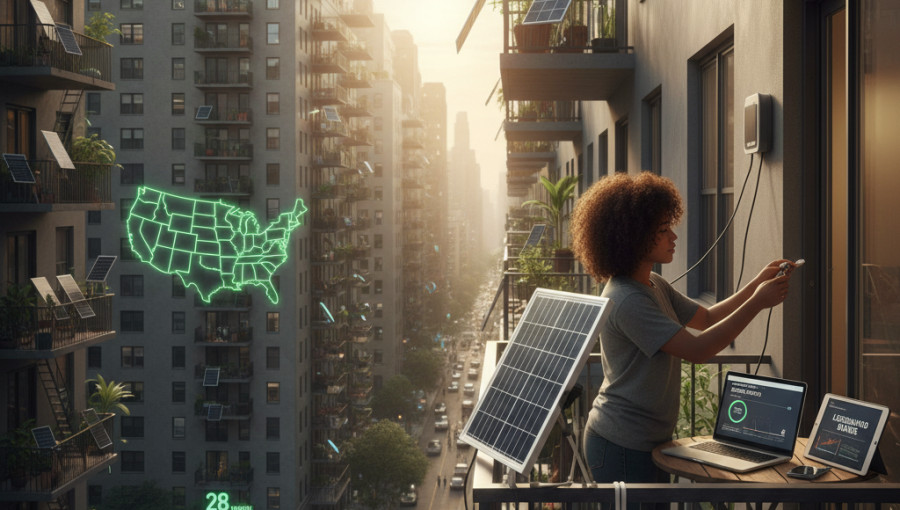
A legislative movement is sweeping across the United States as lawmakers in 28 states and Washington, D.C., push to legalize “plug-and-play” balcony solar systems. While Utah currently stands as the only state with explicit protections for these small-scale installations, a surge of bipartisan bills aims to bypass traditional utility hurdles. These portable devices, which plug directly into standard wall outlets, offer renters and apartment owners a way to combat rising electricity costs and reduce CO2 emission levels without the complex installation requirements of traditional rooftop solar panels.
In the Bronx, attorney Lauren Phillips has transformed her balcony into a miniature power station using a 220-watt solar panel secured with zip ties. Provided by the nonprofit Bright Saver, the installation is expected to cover up to 20% of her family’s energy needs, saving approximately $100 annually. Phillips is part of a small group of early adopters navigating a regulatory gray area, as most American utilities still require lengthy interconnection agreements and fees for any device that feeds power into a home’s electrical system.
The legislative push to simplify this process is gaining momentum. Since Utah passed its landmark law in March 2025, thousands of residents there have adopted the technology. Now, representatives from both sides of the aisle in states like New York, Missouri, and South Carolina are viewing balcony solar as a vital tool for economic relief. In New York, Assemblymember Emily Gallagher has introduced legislation to facilitate small-scale solar, noting that an 800-watt unit could save a typical household over $300 per year by 2035 as utility rates continue to climb.
The technology is already a proven success in Europe, where Germany alone boasts roughly 4 million balcony installations. In the U.S., the primary barrier remains the legal distinction between a large-scale solar module array and a single portable panel. While utilities often cite safety concerns regarding energy back-feeding into the grid, advocates argue that the modest output of these systems—typically capped at 1,200 watts—is almost entirely consumed by the household’s own appliances, posing no threat to grid stability.
Missouri State Representative Mark Matthiesen, a Republican supporter of the technology, emphasizes that these systems allow citizens to invest in their own financial stability. According to Matthiesen, families could see a return on their investment in just over two years. Meanwhile, safety standards are catching up; UL Solutions launched a dedicated testing protocol in early 2026 to certify that these plug-in devices meet rigorous safety requirements, mirroring the path taken by Utah to eliminate the need for utility-specific permission.
As bills progress through committees in states like California, New Jersey, and Illinois, the potential market for balcony solar continues to expand. For residents in high-pollution areas, the shift represents more than just financial savings. Phillips, who has suffered from respiratory issues linked to local air quality, views the democratization of solar power as a matter of environmental justice. By allowing individuals to contribute to a greener grid through simple, accessible technology, proponents believe the U.S. can significantly accelerate the transition to renewable energy at the household level.