
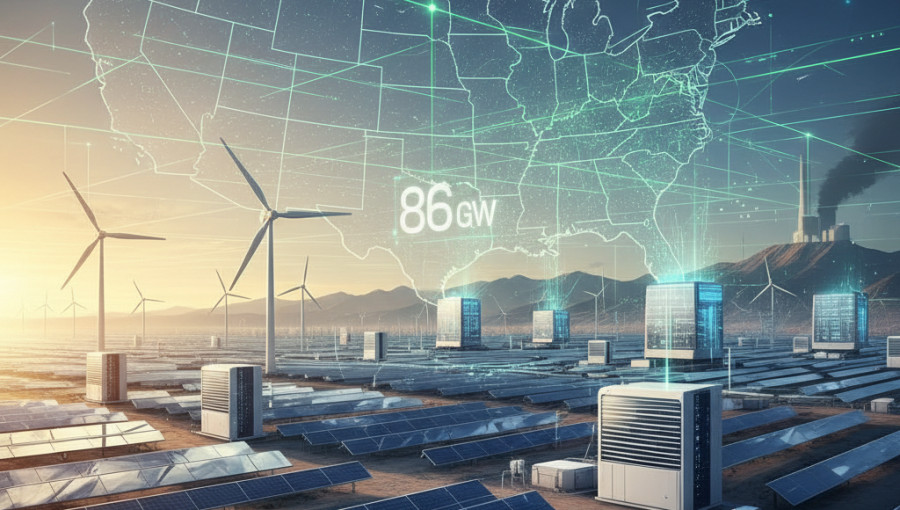
The United States is poised for a historic expansion of its power grid in 2026, with clean energy sources accounting for the vast majority of new capacity. Despite political efforts to favor fossil fuels, federal data indicates that a record-breaking 86 gigawatts of new electricity generation will be added this year. Solar energy leads the surge at 51%, followed by battery storage and wind, while fossil gas accounts for only a small fraction. This shift highlights a market-driven transition fueled by low costs and surging demand from the artificial intelligence sector.
The U.S. Energy Information Administration’s latest projections reveal a transformative year for the domestic power sector. Of the 86 gigawatts of utility-scale capacity scheduled to come online, clean technologies represent 93% of the total. Solar remains the primary driver, contributing over half of all new installations, while battery storage and wind projects contribute 28% and 14%, respectively. In contrast, fossil gas has dwindled to just 7% of new capacity, and coal remains entirely absent from the construction pipeline.
This massive rollout occurs amidst a complex political environment. While the current administration has attempted to prioritize traditional fuels and implement hurdles for renewable development, the private sector continues to favor clean energy. The preference is largely economic; renewables and storage offer faster construction timelines and lower long-term operational costs. These advantages have pushed the 2026 build-out to levels significantly higher than in previous years, including a 33-gigawatt increase over the 2025 figures, which had already set a post-2002 record.
The impact of this transition is particularly visible in California, where solar power is on the verge of overtaking gas as a primary generation source. Nationally, the rapid expansion of the AI industry is providing a new catalyst for solar module deployment. Data center developers are increasingly turning to solar and battery combinations to meet their immense and immediate power requirements.
Although legal and administrative challenges persist—such as permitting delays for projects on federal lands—the momentum of 2026 appears solidified. Even if future policy shifts create friction for offshore wind or land-based installations in the late 2020s, the sheer volume of clean energy infrastructure being commissioned this year provides a substantial boost to the nation’s decarbonization efforts and energy resilience. Regardless of the political climate, the grid is being reshaped by the sheer scale of solar, wind, and battery additions.