
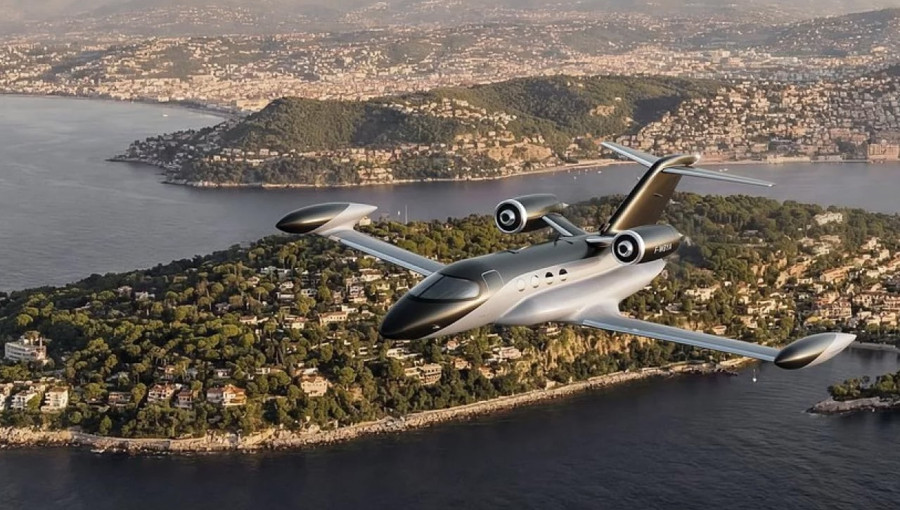
French aerospace firm Beyond Aero has successfully completed the Preliminary Design Review for its BYA-I One, a pioneering hydrogen-electric business jet. This milestone transitions the aircraft into its detailed design phase, targeting a commercial debut by 2030. Utilizing advanced fuel cell technology, the jet promises zero-emission travel, releasing only water vapor during flight. With strong market interest and a design tailored for regional European routes, the BYA-I One aims to redefine private aviation by offering a sustainable, cost-effective alternative to traditional fossil-fuel-powered aircraft.
Since its initial unveiling at the Paris Air Show in 2023, the BYA-I has undergone significant technical refinement. The successful completion of the design review confirms the integration of hydrogen storage, electric propulsion, thermal management, and safety architectures into a certifiable framework. The aircraft’s propulsion system features a twin pusher-configured propfan powered by six 400kW hydrogen fuel cells, producing a total of 2.4MW of power. Gaseous hydrogen is stored at 700 bar in external tanks mounted above the wing, allowing for a rapid refueling process of just 30 minutes.
The performance specifications of the BYA-I One are designed to meet the demands of modern regional travel. The jet can carry up to eight passengers over a range of approximately 1,482 kilometers at a cruising speed of 555 kilometers per hour. It reaches a maximum speed of 666 kilometers per hour and can operate at altitudes up to 7,925 meters. With a takeoff ground roll of only 725 meters, the aircraft is capable of operating from constrained urban hubs and versatile surfaces, including grass and snow.
The interior of the jet emphasizes passenger comfort and efficiency. The cabin measures 1.84 meters wide and 1.7 meters tall, offering more space than many traditional light jets. Large elliptical windows, significantly larger than industry standards, provide an abundance of natural light for the six-seat club configuration. Because the hydrogen-electric system uses 90% fewer moving parts and eliminates high-temperature turbines, maintenance costs are projected to decrease by 60%, while overall operational expenses could fall by as much as 40–60%.
Market reception for the new technology has been robust, with Beyond Aero securing $914 million in Letters of Intent for 108 aircraft. The company is currently working alongside EASA to establish the regulatory “rulebook” for hydrogen-electric flight. By collaborating on these special conditions, Beyond Aero is not only building a new aircraft but also helping to define the certification standards for an entirely new category of sustainable aviation.