
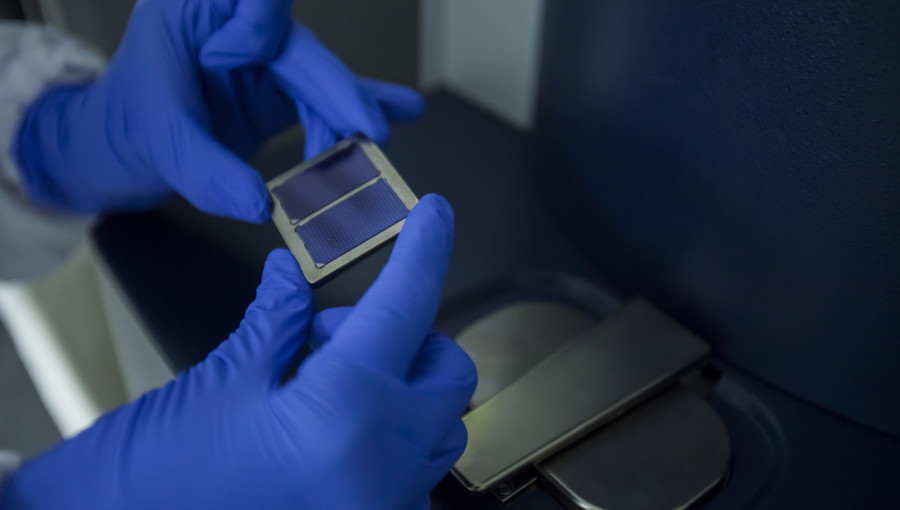
Researchers at the Chinese Academy of Sciences have reached a significant milestone in renewable energy by pushing the efficiency of all-perovskite tandem solar cells beyond the 30 percent threshold. By implementing a novel chemical strategy to synchronize the crystallization process, the team achieved a record 30.3 percent power conversion efficiency for rigid cells and 28 percent for flexible versions. This breakthrough addresses long-standing stability and manufacturing challenges, potentially paving the way for low-cost, lightweight alternatives to traditional silicon-based solar panels.
The research, led by Dr. Ge Ziyi and Dr. Liu Chang from the Ningbo Institute of Materials Technology and Engineering (NIMTE), focuses on all-perovskite tandem solar cells. These devices are increasingly viewed as the future of photovoltaics due to their ability to capture a broader spectrum of sunlight compared to standard single-junction cells. Unlike traditional silicon modules, these can be manufactured using low-temperature solution processing, which significantly reduces production costs and energy consumption.
The primary obstacle the team overcame was the issue of asynchronous crystallization. During the manufacturing of multicomponent perovskite films, different elements often crystallize at varying rates. This inconsistency leads to structural defects and uneven compositions, which ultimately degrade the efficiency and lifespan of the solar cell. To solve this, the scientists utilized the hard-soft acid-base (HSAB) theory to develop a specific additive design strategy.
By introducing tailored additives—difluoro(oxalato)borate for wide-bandgap layers and tetrafluoroborate for narrow-bandgap layers—the researchers managed to synchronize nucleation and crystal growth. This chemical intervention ensured a uniform film distribution and prevented the redistribution of halides, which typically causes internal stress and performance drops. The result was a substantial boost in performance across all components: wide-bandgap solar cell efficiency rose to 20.1 percent, while narrow-bandgap versions reached 23.3 percent.
When integrated into a monolithic architecture, the rigid tandem device achieved a certified peak efficiency of 30.3 percent. This version also demonstrated remarkable durability, maintaining 92 percent of its initial performance after 1,000 hours of continuous operation at the maximum power point. The flexible variants were equally impressive, reaching 28 percent efficiency and retaining over 95 percent of their capacity after being subjected to 10,000 bending cycles.
These advancements, recently published in the journal Nature Nanotechnology, suggest a clear path toward the commercialization of perovskite technology. The high efficiency combined with the physical flexibility of these cells opens new possibilities for wearable electronics, portable power systems, and lightweight solar panel installations that were previously impossible with rigid silicon technology.