
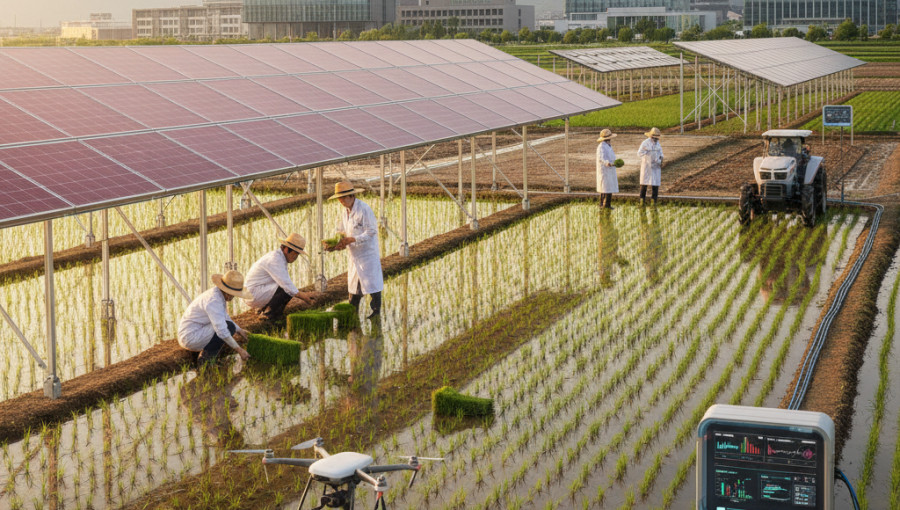
Researchers in Japan have launched a landmark pilot project at Chiba University to integrate rice farming with advanced perovskite solar cell technology. This solar sharing initiative involves installing lightweight, flexible solar modules above active rice paddies to generate renewable energy without sacrificing agricultural land. By monitoring crop yields and power efficiency over the next three years, the study aims to create a sustainable model that boosts farm income and supports Japan’s carbon neutrality goals through innovative agrivoltaic solutions.
The experiment officially commenced with a ceremonial rice planting at Chiba University’s Kashiwanoha Campus in Kashiwa. This pioneering effort explores the practical application of agrivoltaics by positioning thin-film perovskite solar panels over a traditional rice paddy. The primary objective is to demonstrate that electricity generation and food production can coexist harmoniously on the same plot of land, providing farmers with a secondary revenue stream while contributing to a reduction in CO2 emission levels.
Produced by Sekisui Chemical, the perovskite solar cells being used are significantly lighter and more flexible than conventional silicon-based alternatives. This reduced weight allows for simpler mounting structures that do not interfere with the operation of heavy agricultural machinery. To ensure a comprehensive analysis, researchers have also installed standard silicon solar panels on a neighboring plot to compare the durability, power output, and overall impact on crop health between the two technologies.
Over the course of the three-year study, the research team will closely monitor how the partial shading provided by the canopy affects the yield and quality of the rice. While some crops may be sensitive to reduced light, experts suggest that the solar panels might actually benefit the plants by offering protection against the increasingly intense heat of Japanese summers. All electricity generated during the pilot phase will be funneled directly into the university’s campus power grid to support local facilities.
University officials and industry partners view the project as a critical step toward a greener future. Chiba University President Kotaro Yokote expressed his hope that this synergy between modern energy technology and traditional agriculture would serve as a global blueprint for sustainable development. Similarly, Mitsuhiro Higashi, head of Terra Inc., the firm managing the project’s infrastructure, emphasized the potential to export this dual-purpose environmental strategy to other regions facing similar land-use challenges.