Severe Hail Damage Drives Solar Insurance Market Volatility
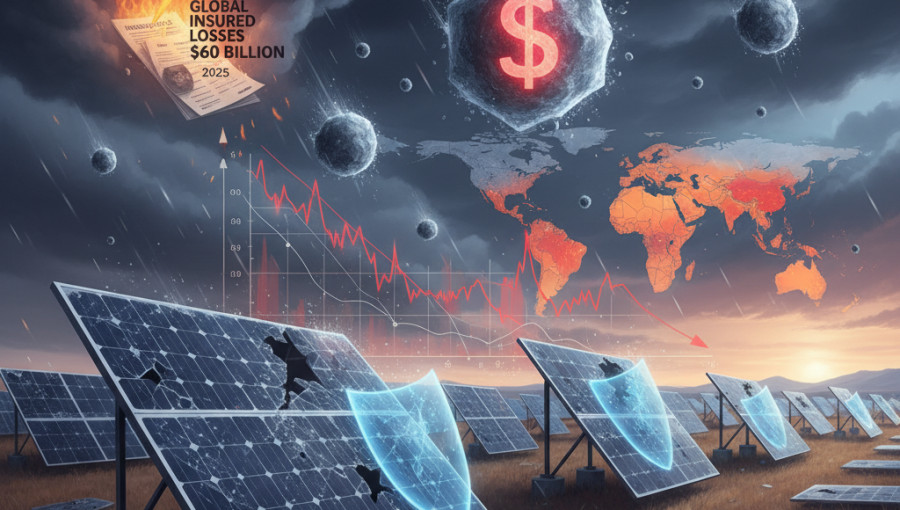
Severe convective storms (SCS) and hail have become the primary drivers of volatility in the solar insurance market, causing $60 billion in insured losses in 2025 alone. As these weather events now account for nearly half of global catastrophe losses, insurers are tightening capacity and raising premiums. The industry is responding by prioritizing advanced mitigation strategies, such as high-angle tracker stowing and site-specific hazard assessments. With over 1 million solar modules damaged since 2019, the shift toward thinner glass technology and expansion into hail-prone regions is forcing a fundamental rethink of solar asset protection and project financing.
According to the "Improving Underwriting for Renewable Assets" report by Gallagher Re, severe convective storms represented at least 47% of all global insured catastrophe losses last year. In the United States, the impact has been particularly pronounced, with SCS and hail responsible for over $200 billion in losses since 2020—surpassing the financial toll of hurricanes during the same period. The year 2025 saw at least 13 separate billion-dollar weather events in the U.S., ranking it as the third-most expensive year on record for insurers regarding these specific atmospheric phenomena, trailing only 2023 and 2024.
Swiss Re Corporate Solutions highlights that while fire remains a significant concern, hail has emerged as the most critical risk for solar PV installations. Industry experts note that the increasing frequency of damaging winds and hailstorms necessitates a shift toward more robust operational resilience. The insurance sector is now placing a heavier emphasis on site-specific hazard assessments and asset design to prevent high-severity events from resulting in total asset loss. This includes a push for clearer emergency response procedures and better coordination with local services.
Detailed claims analysis from AXIS Capital reveals that hail accounted for 27% of all natural catastrophe claims for solar projects between 2019 and 2025. During this period, more than 1 million solar modules were destroyed, leading to $342 million in gross claims. A significant factor in these rising costs is the industry-wide transition to heat-strengthened glass. While these modules offer weight and cost advantages, they result in claims that are, on average, $50,000 per megawatt higher than those involving traditional, thicker tempered glass.
The geographical expansion of solar energy is also contributing to the insurance crunch. Projects are increasingly being built in regions like the eastern and northeastern parts of South Africa or the central United States, where convective weather patterns are historically severe and less understood. Risk engineers suggest that climate change may be intensifying these storms, producing larger hailstones that exceed the original design specifications of many existing plants. Consequently, insurers are becoming more selective, favoring developers who demonstrate excellence in risk management and portfolio diversification.
Effective mitigation has proven to be a game-changer for project viability and insurance costs. Analysis shows that the average cost of a hail-related claim is reduced by approximately 50% when a solar module is successfully moved into a protective "stow" position. Research indicates that for 2.0 mm front glass facing winds of 32 kilometers per hour, the probability of breakage drops by 83% when the tracker stow angle is increased from 30 to 75 degrees. As financial terms for solar projects become increasingly tied to weather resilience, new tools are being launched to help developers quantify site-specific hail exposure before reaching financial close.