
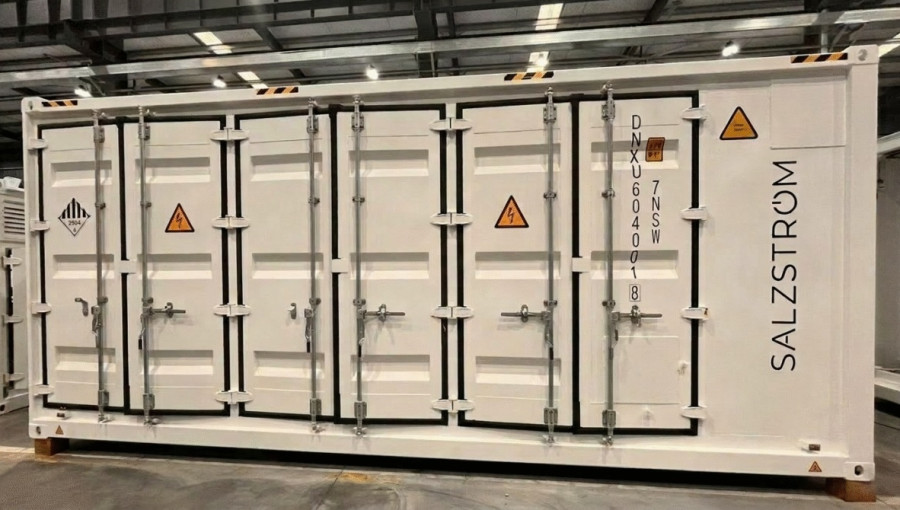
Austrian manufacturer Salzstrom has officially entered the commercial market, securing its first major order for sodium iron phosphate battery energy storage systems. The company is set to supply three battery containers to the German firm Isel-automation by the third quarter of 2026. This project, valued in the seven-figure euro range, will provide a total of 7 MWh of storage capacity across three industrial sites. By integrating these systems with existing solar infrastructure, the initiative aims to demonstrate the viability of sodium-ion technology for industrial energy management and grid optimization across the European market.
The three battery containers, each rated at 2.3 MWh, will be deployed at sites already utilizing approximately 500 kW of solar capacity. Collectively, the systems will feature a power rating of 1.25 MW, with specific configurations tailored to each location. Salzstrom will oversee the entire project lifecycle, encompassing system design, the selection of components, and the integration of power conversion and energy management systems. The company will also handle the commissioning process and provide long-term operational support for the installations.
Salzstrom highlights this deployment as a milestone for the European energy sector, marking the first commercial use of sodium iron phosphate battery containers in the region. The technology utilizes non-flammable cells capable of functioning in extreme temperatures, including discharge capabilities as low as -40 C. This thermal resilience reduces the need for active heating or cooling, which helps lower overall operating costs. Furthermore, the company notes that these batteries exhibit less degradation than lithium iron phosphate alternatives during high-current operations, making them particularly effective for high-power tasks such as peak shaving.
By targeting commercial and industrial users, Salzstrom intends to help businesses lower electricity expenses and maximize the self-consumption of their onsite solar power. The company plans to leverage this initial success to scale its sodium-ion storage solutions throughout Europe, offering a robust alternative for those looking to optimize their grid connection capacity.