
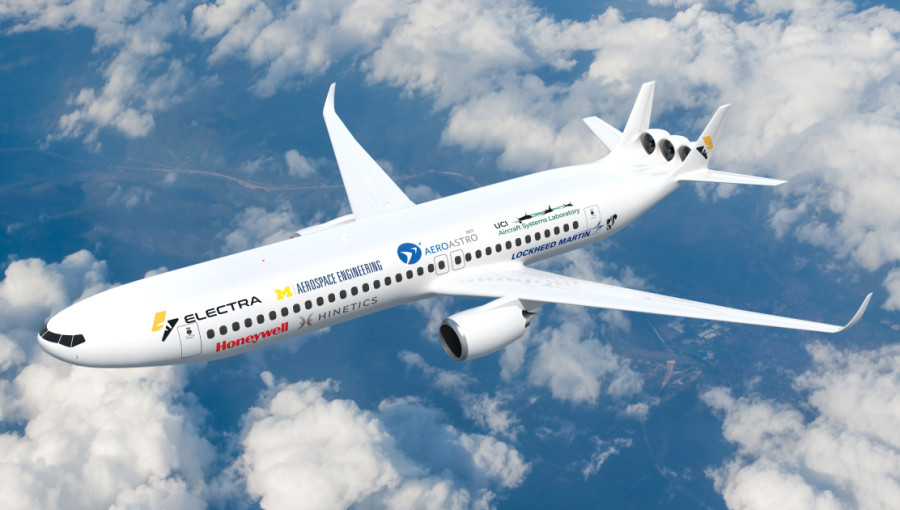
Electra has introduced a hybrid airliner concept designed for the year 2050, developed under NASA’s Advanced Aircraft Concepts for Environmental Sustainability program. The aircraft features a unique “double-bubble” fuselage that generates lift, allowing for smaller wings and improved efficiency. By utilizing a sophisticated hybrid propulsion system that integrates turbofans with rear-mounted electric fans, the design captures and re-energizes boundary-layer air flowing over the fuselage. This innovative approach reduces drag and fuel consumption, aiming to lower emissions while remaining compatible with current airport infrastructure and operational standards, moving beyond simple electric motor retrofits to a fully integrated aerodynamic solution.
The design is rooted in an earlier MIT study known as the D8. Its distinctive fuselage consists of two tubular sections fused together, a configuration that increases internal volume and allows the body itself to contribute significantly to lift. This structural efficiency reduces the load on the wings, enabling a more compact design. The propulsion system is the core of the concept, featuring two turbofans mounted on pylons beneath the wings to ingest clean, uniform air, while three electric fans are embedded at the rear of the fuselage to manage the aircraft’s wake.
This arrangement addresses the energy typically lost to turbulence. As air flows over the fuselage, it creates a thick, slow-moving boundary layer that usually results in a drag-inducing wake. The rear-mounted electric fans ingest this low-energy air, re-energizing it to recover lost energy and boost overall thrust efficiency. This allows for smaller, lighter engines that consume less fuel and produce fewer emissions. While the concept offers significant aerodynamic benefits, engineers must still overcome hurdles related to heat management, complex power transmission, and the noise levels produced by the electric fans.
Dr. Parker Vascik, Director of Product Strategy at Electra, emphasized that the primary advantage of this electrification strategy is the ability to place propulsion components in optimal locations that were previously inaccessible. The objective is to create a synergy between the airframe and the propulsion system that is not only theoretically efficient but also practical for real-world airline operations. By focusing on designs that can be built and certified, Electra aims to ensure that these advancements in efficiency and sustainability can be successfully integrated into the global aviation network.