Agrivoltaic Systems Conserve Water Despite Lower Potato Yields
Recent research from the University of Florence indicates that while agrivoltaic systems can reduce potato yields by approximately 15%, they offer significant advantages in water conservation. By analyzing a 1 MW facility in Italy, researchers found that moderate shading helps retain soil moisture and extends the crop's growth cycle, particularly during high-temperature periods. Despite the slight decrease in total harvest compared to open-field farming, the dual-use approach achieves high land-use efficiency and presents a viable economic model, especially when paired with high rates of energy self-consumption.
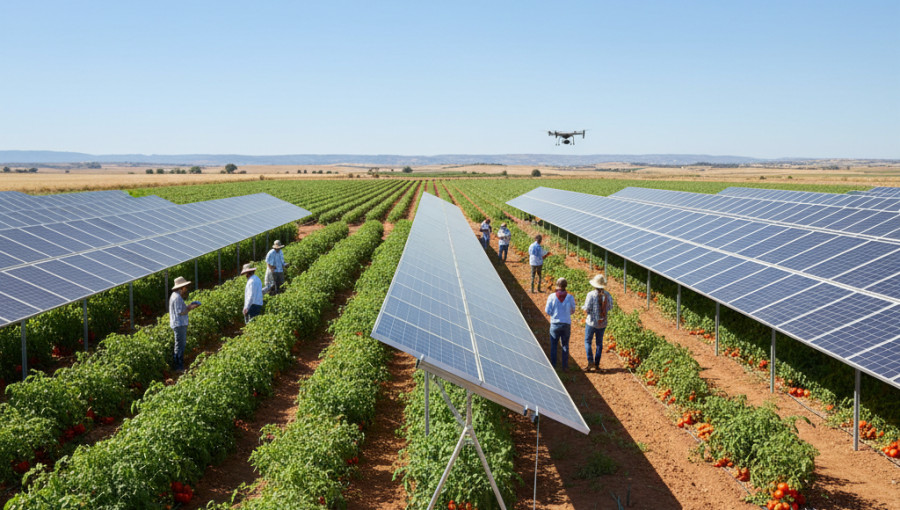
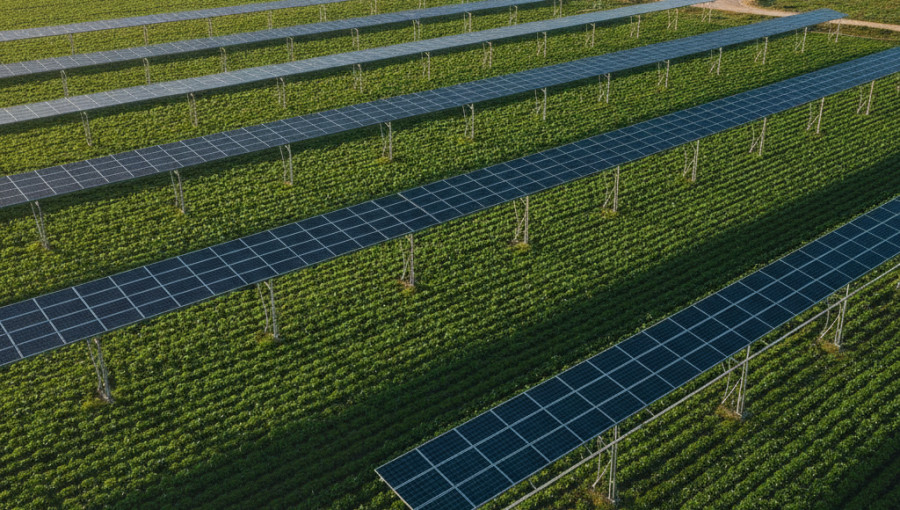
The study, published in the journal Applied Energy, utilized a sophisticated modeling framework to evaluate the synergy between solar energy production and agriculture. The researchers focused on a simulated 1 MW open-stilted agrivoltaic installation near Florence. This system featured monocrystalline solar module units measuring 2 meters by 1 meter, positioned 3 meters above the ground with a 30-degree tilt. To ensure accuracy, the team analyzed 18 years of meteorological data and conducted high-resolution shading simulations at five-minute intervals with a spatial resolution of 13 centimeters by 6.5 centimeters.
Findings revealed that the presence of solar panels can reduce direct irradiance by as much as 55% during the growing season. While this led to a general yield reduction of 15% compared to traditional full-light farming, the microclimate created under the panels offered unexpected benefits. The reduced radiation lowered the temperature of both the soil and the plant canopy, significantly decreasing evaporative demand. This allowed the potatoes to maintain a better water status for longer periods, delaying the onset of senescence and extending the window for biomass accumulation.
Andrea Ademollo, the study’s corresponding author, noted that while intense shading can limit photosynthesis, moderate shading acts as a buffer against water stress. In some specific areas of the field, local yields actually saw a slight increase, though the overall per-hectare average remained lower than open-field benchmarks. Despite the lower potato output, the system demonstrated a land equivalent ratio of 1.58, suggesting that the combined production of food and energy is far more efficient than dedicated land use for either purpose alone.
From an economic perspective, the agrivoltaic configuration showed a levelized cost of energy of €0.084 per kWh, which is higher than the €0.061 per kWh associated with traditional ground-mounted PV systems. The financial viability of such projects depends heavily on electricity self-consumption. On abandoned land with 70% self-consumption, the facility reached a 13% internal rate of return with a 10-year payback period. The researchers concluded that while the financial gap between agrivoltaics and ground-mounted systems remains, reduced crop revenue losses on active farmland help make the dual-use technology increasingly competitive.