
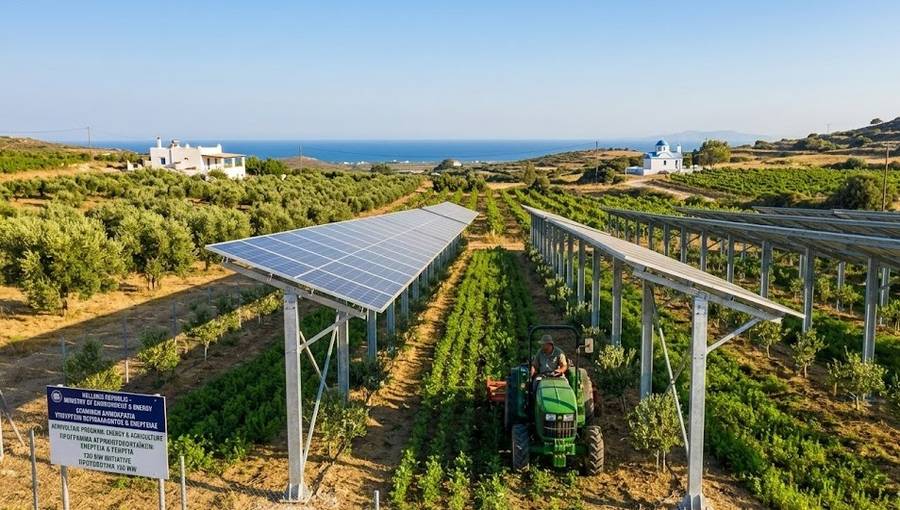
Greece is launching a new 130 MW agrivoltaic program starting March 4, as the national distribution grid operator begins accepting applications for dual-use solar installations. The initiative, established under recent legislation, allocates 10 MW of capacity to each of the country’s 13 regional prefectures. Exclusively available to farmers, the scheme allows for individual systems up to 200 kW, providing a framework for agricultural professionals to diversify their income while contributing to the nation’s renewable energy targets through innovative land-use strategies.
Under the new regulations, eligible farmers can own a maximum of two agrivoltaic systems. To ensure agricultural activity remains viable beneath the installations, the law mandates that solar structures must be positioned at least 2.1 meters above the ground. These systems can be situated on active farmland or integrated into greenhouse rooftops. The program also encourages the inclusion of battery storage solutions, provided they offer at least one hour of discharge duration at maximum output. However, these storage units are strictly prohibited from drawing power from the national grid.
The application window will open during the first ten days of every month until the 10 MW threshold for each specific prefecture is met. The distribution operator will process submissions on a first-come, first-served basis, covering both the mainland and non-interconnected islands. All applicants must provide financial security in the form of bank guarantee letters to qualify for the program and ensure project completion.
Successful participants will enter into long-term contracts for the electricity generated. For projects on the main grid, agreements will be signed with DAPEEP, the Operator of Renewable Energy Sources, while island-based projects will contract directly with the distribution grid operator. While the specific fixed tariff rates have yet to be finalized, the Ministry of Environment and Energy is expected to announce the pricing structure in the coming weeks. High demand is anticipated as the agricultural sector looks to capitalize on these new energy opportunities.