Growing Food And Power On American Farmland

The practice of integrating solar power generation with agriculture, known as agrivoltaics, is increasingly seen as a vital solution to land-use conflicts across rural America. This dual-purpose approach offers farmers a stable new source of income, enhances crop yields in arid climates through shading, and conserves water. By aligning the goals of renewable energy developers with the needs of farmers and local communities, agrivoltaics provides a promising path to expand clean energy while preserving agricultural land and strengthening rural economies against future challenges.
A rising demand for electricity in the United States, driven by data centers, industrial growth, and vehicle electrification, is fueling a rapid expansion of solar energy farms. This has created a direct conflict over land, as the open, flat terrain ideal for solar installations is often also prime farmland. According to the National Renewable Energy Laboratory, solar projects could occupy as much as 10 million acres by 2050. Agrivoltaics offers a cooperative model to de-escalate this tension, allowing land to simultaneously produce both food and clean energy, which can help mitigate community opposition to converting agricultural areas for solar development.
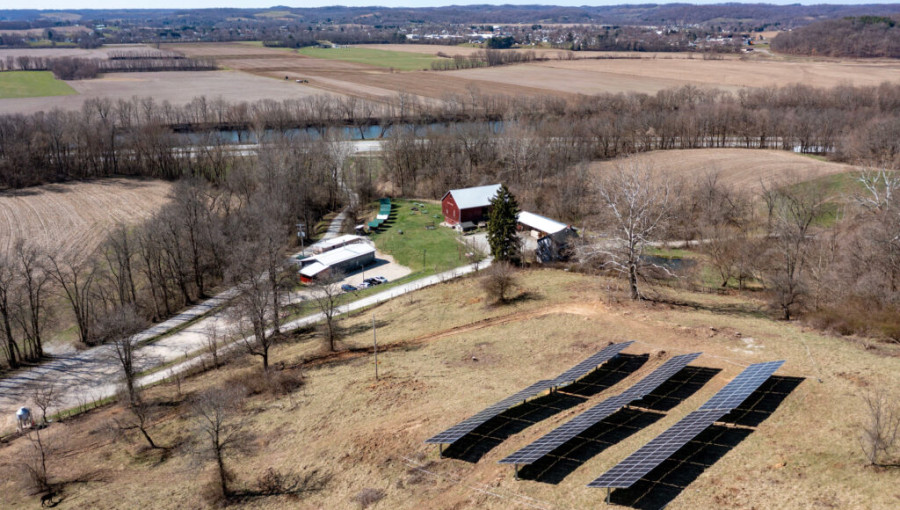
Agrivoltaics can be adapted to a wide variety of agricultural settings. In the United States, common applications include planting native, pollinator-friendly vegetation between solar panels and using sheep for "solar grazing" to manage plant growth. In arid regions, the shade from solar arrays creates a cooler microclimate that benefits specialty crops like peppers and leafy greens by retaining soil moisture and reducing wind stress. Research indicates this practice can lead to healthier soils with more organic carbon and nutrients, thereby protecting against erosion and improving overall farm productivity.
For farmers, especially those managing small to mid-sized operations in a volatile market, agrivoltaics can serve as an essential economic support. Solar lease agreements provide a guaranteed annual income of $450 to $2,500 per acre under contracts that typically last 25 to 30 years. Studies have shown that for certain shade-tolerant crops, these integrated systems can achieve a break-even point in just three years and increase a farm's overall value by as much as 30%. In drought-affected areas like the Mountain West, the results are even more significant, with some crop yields doubling or tripling while requiring half the usual irrigation.
Livestock producers also stand to benefit from this integrated approach. Solar grazing, where sheep are used to control vegetation under solar panels, can reduce a solar developer's mowing and maintenance costs by up to 50%. In return, farmers can generate between $244 and $262 per acre in net income from these grazing contracts. This practice not only opens up a new revenue stream but also improves soil health through natural manure cycling. Emerging research suggests that by elevating panels to a height of about 2.4 meters (eight feet), even larger livestock like cows can graze safely, taking advantage of the shade and improving pasture recovery during dry seasons.
The ultimate success of agrivoltaics also relies on financial and ownership structures that distribute the benefits widely. While land leases are a common model, community-owned cooperatives can ensure that profits are shared more broadly and help build stronger local support. The 3.2-megawatt Lime Kiln facility in Maryland serves as a key example, providing discounted electricity to 500 households while also supporting sheep grazing and pollinator habitats. Such inclusive frameworks help ensure the economic gains from solar development bolster the entire community, not just a select few landowners.
Despite its clear promise, the widespread adoption of agrivoltaics faces considerable hurdles. A major setback occurred when the U.S. Department of Agriculture announced it would no longer fund solar projects through the Rural Energy for America Program (REAP), which had made many farmer-owned systems viable by covering up to half their cost. Other challenges include burdensome permitting processes, liability concerns, and a lingering lack of trust among some farmers. Experts suggest that establishing a standardized definition for agrivoltaics and aligning existing incentives could reduce uncertainty and accelerate its adoption as a mainstream strategy for rural resilience.