
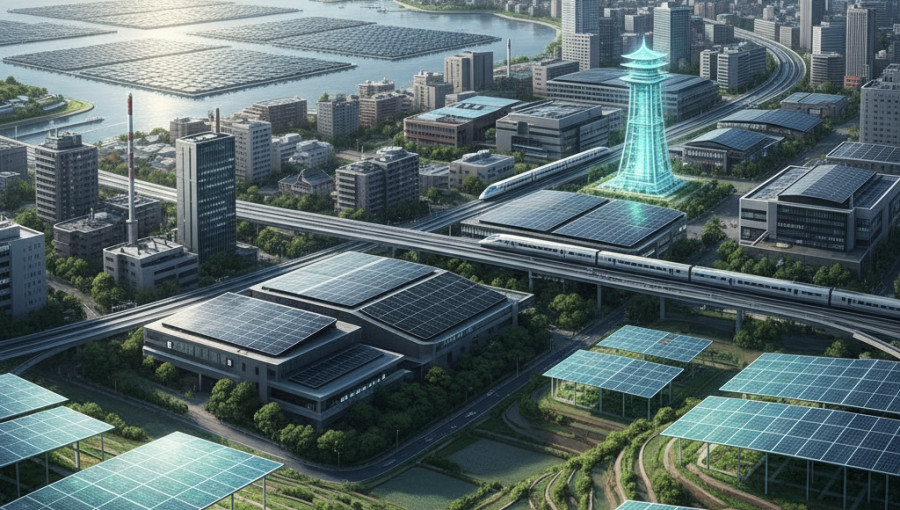
Japan’s solar energy sector reached a significant milestone in 2025, with estimates indicating that the country added between 5.8 GW and 6 GW of new capacity. This surge has likely pushed Japan’s total installed solar power beyond the 100 GW mark. Growth was primarily driven by strong performance in the commercial and industrial sectors, alongside new residential mandates in major cities like Tokyo. As the government transitions its incentive programs, solar is positioned to become the nation’s primary electricity source by 2040 under the latest national energy strategy.
According to data from Tokyo-based consultancy RTS Corp, the 2025 expansion brings Japan’s total cumulative capacity firmly into triple digits. The year’s growth was balanced across various sectors: the utility-scale segment led with 2.2 GW for projects exceeding 1 MW, followed by 2 GW in the commercial and industrial (C&I) market, and 1.6 GW from residential installations. While traditional Feed-in Tariff (FiT) and Feed-in Premium (FiP) programs remained influential, there is a notable rise in corporate power purchase agreements signed independently of these government schemes.
Local government initiatives have played a crucial role in boosting residential figures. Since April 2024, the Tokyo Metropolitan Government has required solar systems on all newly constructed homes, a policy mirrored by the city of Kawasaki. Looking ahead, analysts expect installation rates in 2026 to remain steady. However, a potential “rush” may occur before fiscal year 2027, when the government plans to phase out FiT and FiP incentives for solar systems with a capacity of 10 kW or larger.
Japan’s seventh strategic energy plan, finalized in early 2025, solidifies solar energy’s role as the cornerstone of the country’s future power grid. By 2040, the government aims for renewables to provide 40% to 50% of the nation’s electricity, with solar alone accounting for up to 29% of total generation. This would require an estimated 203 GWac to 280 GWac of total capacity. To reach these ambitious goals, the industry is looking toward agrivoltaic projects and next-generation technologies. The government is currently subsidizing the deployment of perovskite solar cell technology, targeting 20 GW of capacity from this source by 2040.
Throughout 2025, Japan conducted four utility-scale solar auctions to secure further capacity. Results showed varying prices, with the 24th auction achieving a low average of JPY 4.06 per kWh. As of early 2026, the application process for the 27th auction round is already underway, signaling continued momentum despite tightening regulations on large-scale utility projects. Experts suggest that further easing of regulations surrounding agrivoltaic developments will be essential for the country to maximize its available land for energy production.