Long Duration Energy Storage Expands Despite Falling Investment
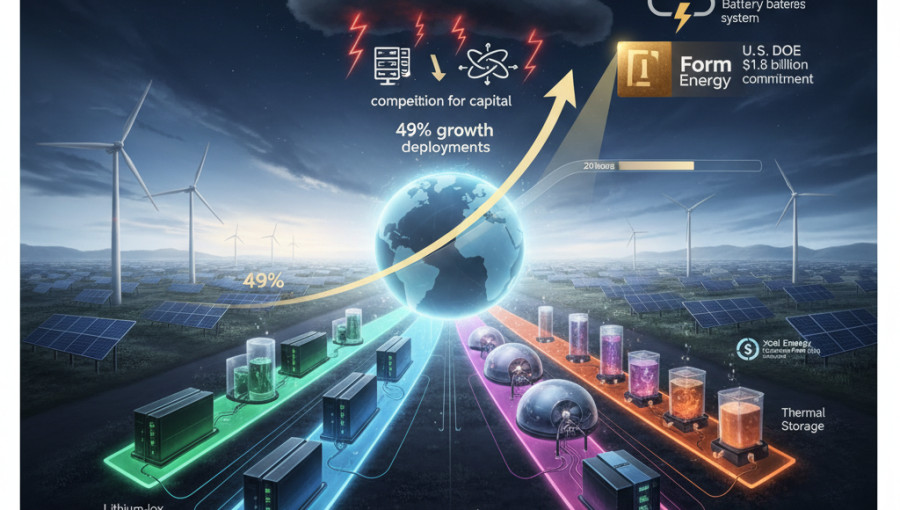
Global deployments of long-duration energy storage (LDES) expanded by 49% in 2025, according to a recent Wood Mackenzie report. While the sector continues to grow, lithium-ion technology is increasingly dominating the market due to plummeting costs and established supply chains. To reach net zero targets, the report suggests that average storage durations must jump from 2.5 hours to approximately 20 hours. Despite a cooling investment climate and a 30% drop in overall funding, large-scale projects like iron-air batteries and compressed air systems are moving toward commercialization to support grid reliability.
Wood Mackenzie's analysis highlights a significant shift in the energy storage landscape. While LDES deployments saw a massive 806% surge between 2023 and 2024, the growth moderated to a more stable pace last year. Lithium-ion batteries are projected to maintain an 85% market share through 2034, leaving emerging technologies like vanadium redox flow batteries (VRFB) and compressed air energy storage (CAES) with just 5% and 3% of the market, respectively. The dramatic cost reductions achieved by lithium-ion over the last decade have created a high barrier for entry for newer LDES technologies.
The investment environment for alternative storage technologies has become notably more difficult. Excluding a significant $1.8 billion commitment from the U.S. Department of Energy to the Canadian firm Hydrostor, global funding for LDES fell by 30% in 2025. Venture capital investment saw an even steeper decline of 72%. Analysts attribute this downturn to persistently high interest rates and the diversion of capital toward grid infrastructure and power-hungry AI data centers, which are competing for the same investment pools.
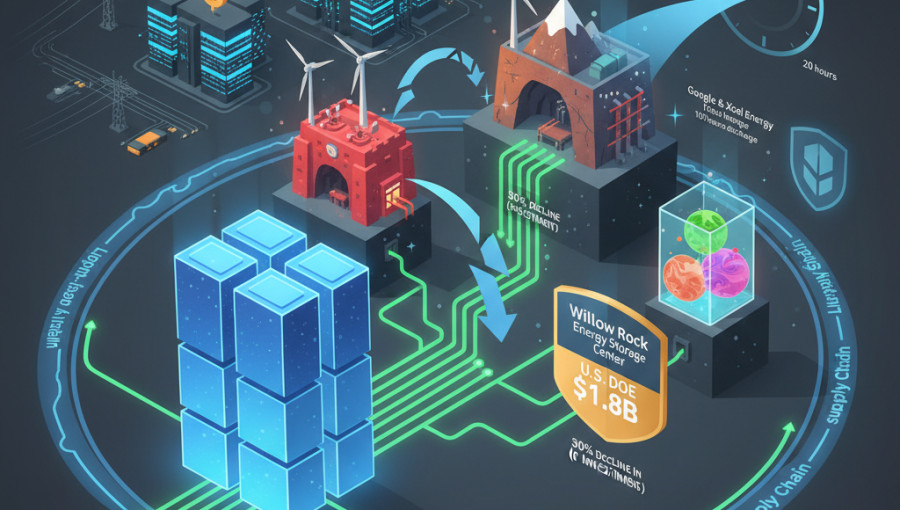
Despite these financial headwinds, several landmark projects are progressing toward operation. Hydrostor is preparing to break ground on its Willow Rock Energy Storage Center in California, a 500 MW facility designed to store compressed air in underground caverns for up to eight hours of discharge. The facility is expected to have an operational lifespan of 50 years. Meanwhile, Form Energy has partnered with Google and Xcel Energy to deploy a 300 MW/30 GWh iron-air battery system in Minnesota. This project, which utilizes a "reversible rusting" process to store and release energy, represents the largest battery capacity announced to date and can provide 100 hours of continuous power.
Policy frameworks and state-level mandates are providing a crucial tailwind for the industry. California has committed to procuring 1 GW of both intraday and multiday storage to balance its renewable energy portfolio. Utilities such as Xcel Energy view these technologies as essential for meeting 100% carbon-free mandates by 2040, particularly during extended periods of low wind and solar generation. As intermittent renewable energy resources expand, the transition from short-term to long-duration storage remains a critical pillar for maintaining a reliable and decarbonized power grid.