New Solar Battery Stores Energy As Green Hydrogen
Researchers in Germany have developed an innovative copolymer-based solar battery capable of storing energy from sunlight for several days before releasing it as green hydrogen. Created by teams at the universities of Ulm and Jena, the system boasts high efficiency, reaching 80 percent during charging and 72 percent during discharge. This breakthrough offers a scalable and cost-effective method for producing carbon-free fuel on demand, potentially revolutionizing how renewable energy is stored for industries ranging from transportation to heavy manufacturing.
As the global energy transition accelerates, solar and wind power are becoming central to reducing CO2 emission. However, for energy-intensive sectors, hydrogen remains a more effective alternative due to its high energy density. While conventional hydrogen production often relies on carbon-heavy methane reforming, green hydrogen produced via renewable energy offers a truly sustainable path. Traditionally, this requires separate production and storage facilities, but this new German technology integrates both processes into a single molecular system.
The research team, led by Ulrich Schubert and Sven Rau, utilized specialized macromolecules known as copolymers. These structures serve as a stable framework for water-soluble units with high redox activity. When exposed to sunlight, the copolymer captures energy with 80 percent efficiency. Unlike traditional batteries that may lose charge over short periods, this chemical-based storage can hold its energy for several days.
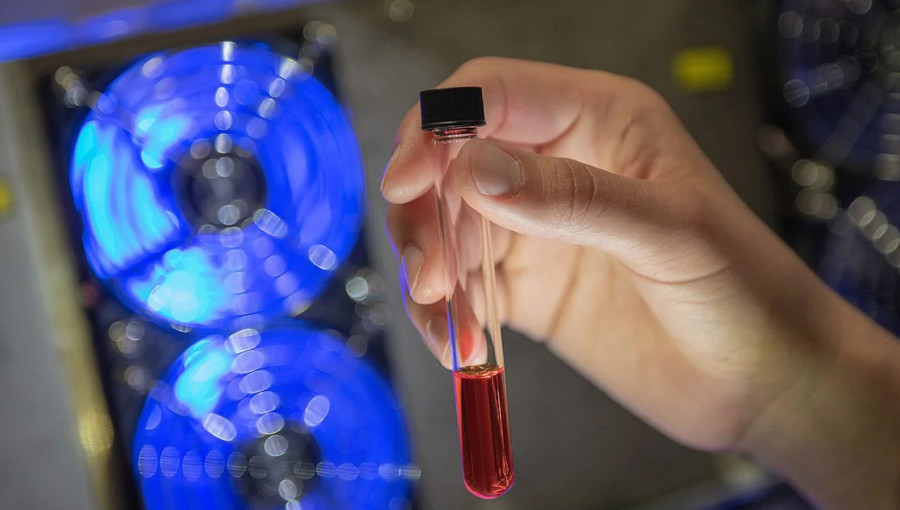
To retrieve the stored energy, the researchers employ a unique pH-controlled mechanism. By adding an acid and a specific catalyst, the system triggers a reaction where stored electrons combine with protons to generate hydrogen gas. This discharge process is remarkably efficient, maintaining a rate of 72 percent. Furthermore, the pH level acts as a visual indicator: the polymer shifts from yellow to violet when fully charged and returns to yellow once the energy is released.
This reversible system allows for multiple cycles of charging and discharging, making it a robust candidate for industrial applications. The released hydrogen can be utilized for generating clean electricity, powering electric vehicles, or decarbonizing steel production. By merging macromolecular polymer chemistry with photocatalysis, the researchers have created a versatile building block for a sustainable, chemical-based energy economy. The full findings of this study were recently published in the journal Nature Communications.