Solar Panels And Rice Fields Thrive Together In Japanese AgriSolar Pilot

The article from SPIE, titled "Solar panels and rice fields thrive together in Japanese agrivoltaics pilot," published on August 4, 2025, details a pioneering study led by researchers from the University of Tokyo. This study explores the integration of solar energy generation with rice farming through a practice known as agrivoltaics, addressing the critical challenge of balancing renewable energy production with food production, particularly in Japan, where mountainous terrain limits arable land. Below is a detailed summary of the study, its methodology, findings, implications, and future directions, as reported in the Journal of Photonics for Energy.
Background and Context
Japan faces significant challenges in expanding its renewable energy infrastructure due to limited flat land, with much of its terrain being mountainous. This scarcity creates a tension between allocating land for solar energy projects and preserving it for agriculture, particularly rice farming, a cornerstone of Japanese culture and food security. Agrivoltaics, which combines photovoltaic (PV) systems with crop cultivation on the same land, offers a potential solution to this dilemma. The University of Tokyo’s study investigates whether agrivoltaics can produce competitive solar power while maintaining high-quality rice yields, thereby supporting both energy and food security.
Methodology
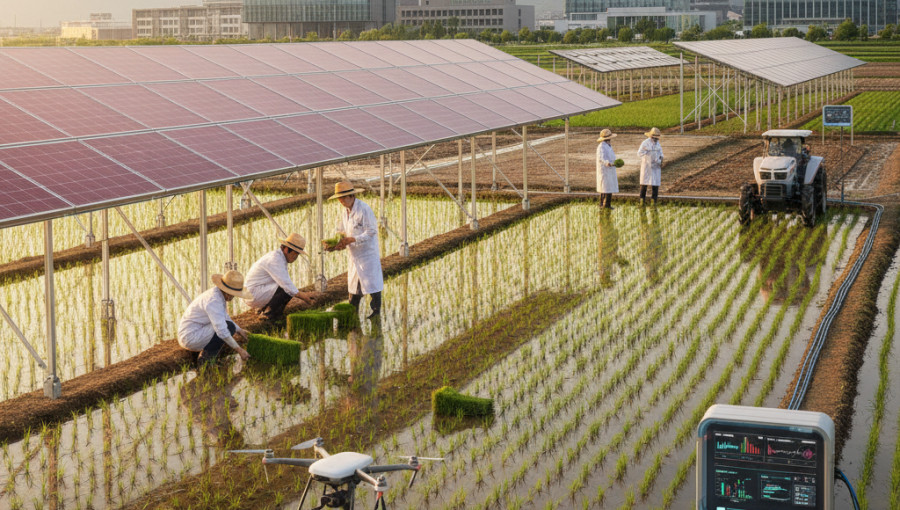
The research team installed a dual-axis sun-tracking photovoltaic system over a rice paddy in Miyada-mura, Nagano Prefecture. Key features of the setup include:
- System Design: The solar panels were positioned three meters above the ground, allowing rice cultivation to continue underneath. The dual-axis tracking system enabled the panels to adjust their angles daily and seasonally, optimizing sunlight distribution based on agricultural and energy priorities.
- Adaptive Shading: During the rice growing season, the panels were tilted to minimize shading, ensuring sufficient sunlight for photosynthesis and crop growth. In the off-season, the panels were adjusted to maximize solar exposure for electricity production.
- Study Duration: The experiment spanned two growing seasons, allowing researchers to assess performance over time and make iterative improvements.
- Metrics Evaluated: The study measured rice yield, grain quality, electricity production, and economic viability. A nearby traditional rice paddy without solar panels served as a control for comparison.
Key Findings
The study yielded significant results in both agricultural and energy production, demonstrating the feasibility of agrivoltaics in a temperate climate like Japan’s:
1. Rice Yield and Quality:
- In the first year, rice yields under the agrivoltaic system were 75% of those in the control paddy, indicating a moderate reduction due to shading.
- In the second year, after fine-tuning the panel angles to optimize sunlight reaching the crops, yields improved to 85% of the control paddy’s output.
- Importantly, the rice produced under the agrivoltaic system met Japan’s highest grain quality standards, confirming that the system did not compromise crop quality.
2. Electricity Production:
- The PV system generated approximately 44,000 kilowatt-hours (kWh) of electricity annually, with an efficiency of 961.4 kWh per kilowatt of installed capacity. This performance is competitive with similar agrivoltaic systems in Europe.
- The dual-axis tracking system allowed for dynamic optimization of energy output, particularly during non-growing seasons when shading was less critical.
3. Economic Viability:
- Over a projected 20-year lifespan, the estimated levelized cost of electricity production was approximately 27 yen per kWh, without government subsidies. This cost is roughly equivalent to Japan’s household electricity rates at the time, suggesting commercial competitiveness.
- The system’s ability to generate revenue from electricity while maintaining significant agricultural output highlights its economic potential.
4. Tradeoffs and Optimization:
- The study emphasized the importance of managing shading to balance crop productivity and energy output. The dual-axis system’s ability to adjust panel angles in real time was critical to achieving this balance.
- Initial yield reductions in the first year were attributed to excessive shading, but adjustments in the second year demonstrated the system’s adaptability.
Implications
The findings have significant implications for Japan and other land-constrained regions:
- Land Use Efficiency: Agrivoltaics allows for dual land use, enabling countries like Japan to expand solar capacity without sacrificing agricultural land. This is particularly relevant as Japan aims to significantly increase its solar energy capacity by 2030.
- Sustainability and Food Security: By maintaining high-quality rice yields, the system supports food security while contributing to clean energy goals, aligning with global sustainability objectives.
- Economic Resilience: The integration of energy and agriculture can bolster rural economies by providing farmers with additional revenue streams from electricity sales, potentially stabilizing agricultural communities.
- Scalability: The study offers a scalable model that can be adapted to other crops and regions with similar land constraints, making it a blueprint for global agrivoltaic adoption.
Future Directions
The researchers identified several avenues for further improving agrivoltaic systems:
- AI Integration: Incorporating artificial intelligence to analyze sunlight intensity, weather patterns, and crop growth metrics could enable real-time optimization of panel angles, further enhancing both energy and crop yields.
- Advanced PV Technologies: Experimenting with high-efficiency or semi-transparent solar panels could reduce shading impacts, allowing more sunlight to reach crops without compromising energy production. Such technologies could strengthen the synergy between photosynthesis and photovoltaic performance.
- Broader Applications: The success of this pilot suggests potential for applying agrivoltaics to other crops and regions, with tailored adjustments to panel design, crop selection, and local climate conditions.
Broader Context
The study aligns with global efforts to address the competing demands of renewable energy expansion and food production. Other research, such as a six-year field experiment in Chikusei, Japan, reported by pv-magazine.com, found that while rice yields under agrivoltaics were reduced by 23% due to lower biomass and panicle numbers, the gross return (combining rice and electricity revenue) was 14 times higher than traditional farming. This reinforces the economic potential of agrivoltaics, though it highlights the need to address yield reductions through technological innovation.
Conclusion
The University of Tokyo’s agrivoltaics pilot demonstrates that dual-axis sun-tracking photovoltaic systems can successfully integrate solar energy production with rice farming, achieving competitive electricity output and high-quality crop yields. By carefully managing shading through adaptive panel adjustments, the system addresses the tradeoffs between energy and agriculture, offering a sustainable and economically viable model for land-constrained regions. With Japan’s ambitious solar goals and global interest in agrivoltaics growing, this study provides a compelling case for broader adoption, supported by future advancements in AI and photovoltaic technologies. The research, published as “Case study of rice farming in Japan under agriphotovoltaic system” by Y. Okada et al. in the Journal of Photonics for Energy (DOI: 10.1117/1.JPE.15.032704), underscores the potential of agrivoltaics to harmonize ecological stewardship, technological innovation, and food security.