Tesla YouTuber Stranded In Atacama Desert Uses Solar Power
A YouTuber’s ambitious transcontinental expedition faced a critical setback in the heart of the Atacama Desert when his Tesla Model X ran out of power. Sandro van Kuijck, documenting his journey from northern Canada to southern Argentina, was forced to deploy a hood-mounted solar panel to sustain his vehicle’s systems after a 0% battery state left him stranded. While the improvised solar setup provided a minimal energy buffer, the ordeal underscores the persistent infrastructure gaps facing electric vehicle travelers in remote regions of South America.
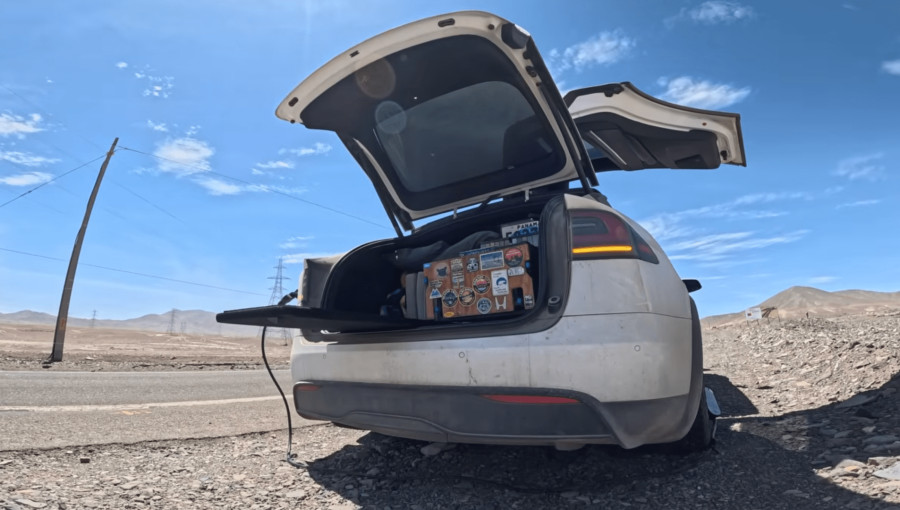
Van Kuijck, the creator behind the "EverydaySandro" YouTube channel, has spent three years navigating the Pan-American Highway. His Tesla Model X is heavily modified for overlanding, featuring a slide-out kitchen, induction cooktop, and sleeping quarters. To support these off-grid needs, the vehicle is equipped with a 287-watt hood-mounted solar panel connected to a 2 kWh EcoFlow Delta 2 battery.
The emergency occurred in northern Chile, south of Calama. Despite starting the leg with a 95% charge from a local fast-charging station, the combination of a steep climb to nearly 2,987 meters and relentless desert headwinds drained the battery faster than anticipated. With approximately 37 kilometers of estimated range remaining and the nearest charger still 42 kilometers away, the vehicle eventually lost all propulsion along the highway.
While stranded, Van Kuijck used his solar panel to harvest between 180 and 200 watts of power. This setup allowed the Tesla to recover roughly 1 to 2 kilometers of range per hour—a slow process that served more to stabilize the high-voltage battery and power onboard electronics than to provide a practical means of travel. This trickle charge capability offers a unique, albeit slow, fallback for electric vehicles that internal combustion engines lack once their fuel tanks are empty.
The situation grew more dire when the auxiliary house battery also depleted, and local towing services were unable to provide immediate assistance. Relief finally arrived via a road construction crew working nearby. The workers allowed Van Kuijck to connect to an industrial generator, providing a 6-amp charge that stabilized the vehicle and prevented a total system shutdown.
This incident highlights the uneven development of electric vehicle infrastructure across the continent. While Tesla launched its first South American Supercharger stations in Chile in late 2024, coverage remains concentrated near Santiago. Although plans are underway to expand the network with 250 kW stalls at various service stations, significant gaps remain along the Pan-American Highway, particularly through the Atacama Desert, requiring explorers to rely on meticulous planning and alternative energy sources.